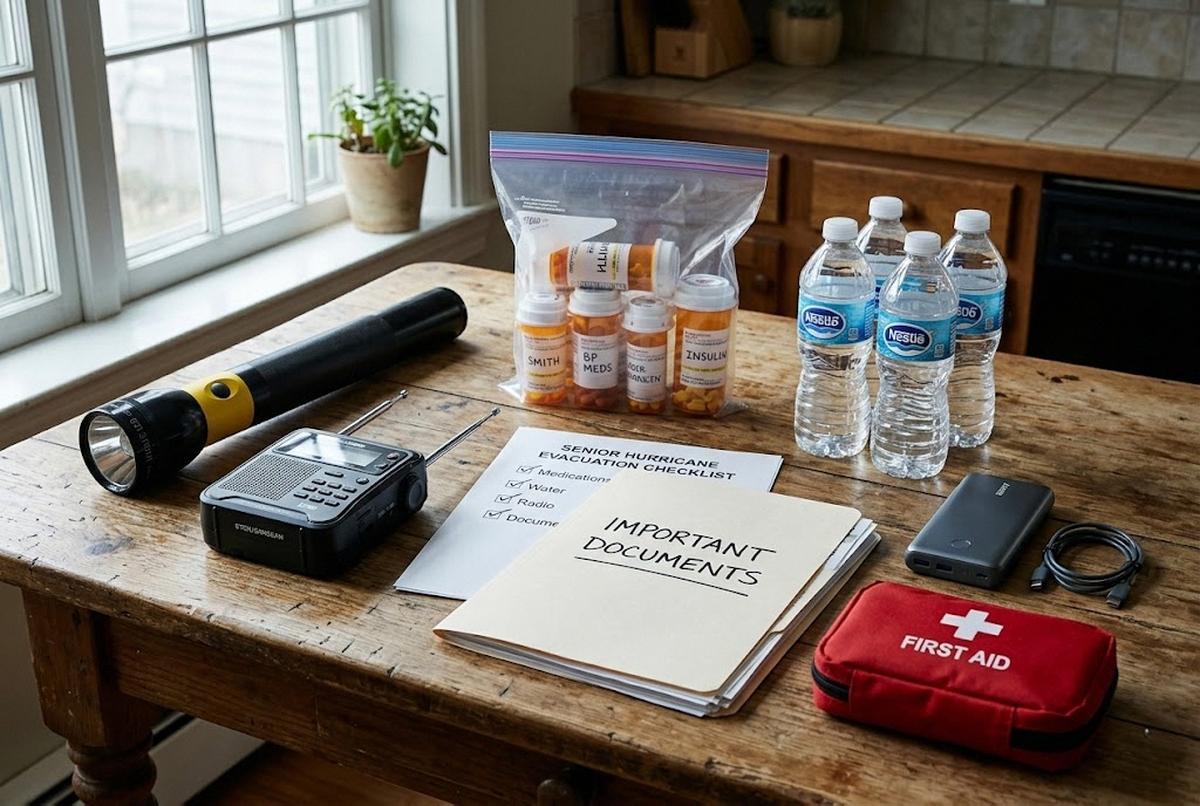
Mrs. Sorrentino loaded her oxygen concentrator into the trunk of a 2014 Honda Civic at 6:14 in the morning in September 2024, a day and a half before Hurricane Helene made landfall in Florida's Big Bend, well north of Tampa. She is 81, a widow, lives alone in a single-story house in Pasco County, Florida, and her daughter Renee was on the phone from Atlanta walking her through the steps. The concentrator is the size of a small suitcase. The cord wraps around it. The backup battery, charged the night before, sat in a canvas tote on the passenger seat next to a manila envelope containing every prescription bottle she takes (seven of them, including a controlled substance for nerve pain that her plan won't fill more than two days early under any circumstance).
She got out. She made it to her niece's house in Ocala by lunchtime. Had she stayed and lost power for days, as many Florida households did after Helene, that would have meant days without an oxygen concentrator and a refrigerator full of insulin pens.
Not every Mrs. Sorrentino gets out. The record on older adults in disasters reads like a long, quiet indictment. After Hurricane Ian in 2022, the National Hurricane Center found that deaths skewed heavily toward older people, consistent with other storms in which the oldest die at the highest rates. The pattern repeats in every major storm: Katrina, Irma, Helene. The reasons are layered: mobility limitations, medication dependence, social isolation, the false confidence that comes from having ridden out twenty seasons before. The 2026 Atlantic hurricane season runs from June 1 through November 30. Colorado State University is forecasting 13 named storms, 6 hurricanes, 2 major hurricanes, a slightly below-average year on paper. Below average is still a season. Below average is still Helene.
What I'd tell you if you were sitting in my office on Post Road is not the Boy Scout version of hurricane prep. It's the version tuned to the body you actually have, the medications you actually take, and the equipment that actually keeps you breathing.
What "Below Average" Doesn't Mean
A quieter season is not a safer season for someone over 70.
The storm count never matched the death toll for older adults. 1992 had only six named storms. One of them was Andrew. 2022 wasn't a record-breaker for storm count either. Ian still killed about 150 people in Florida, and the deaths skewed toward the elderly. Forecasts measure activity. They do not measure your individual exposure. If you live in a coastal county, on a barrier island, in a manufactured home park, in a building without backup power, in a household where the only driver has cataracts, the season's name doesn't matter to you. Your geography does.
The Special-Needs Shelter List Most People Have Never Heard Of
Every state with a hurricane coast runs some version of a special-needs shelter program. Florida calls it the Special Needs Registry. Texas has the State of Texas Emergency Assistance Registry (STEAR). North Carolina runs it through county emergency management offices. The Carolinas, Georgia, Alabama, Mississippi, Louisiana all run a version. Same idea, different name.
The registry is a county-administered list of residents who need medical accommodations during an evacuation: a bed instead of a cot, electrical outlets for medical equipment, a refrigerator for insulin, staff trained to handle oxygen tanks and dialysis schedules, sometimes ambulance transport from your front door to the shelter itself. Florida has been the loudest about it. Their registry covers people with cognitive impairments, mobility limitations, electrical-dependent equipment, and chronic conditions requiring monitoring. You self-register. A nurse or paramedic from the county may call to confirm.
You must register before a storm forms. Not the day of. Not when the cone shows your name on it. Some counties stop taking new registrations as a storm approaches, and the trained staffing for these shelters has to be planned weeks ahead. A client in Sarasota told me her county registry took 11 minutes to fill out online and a follow-up phone call a week later. The entire commitment. Search your county's name plus "special needs registry." If nothing comes up, call your county emergency management office. The receptionist will know.
A caveat I want to be direct about: special-needs shelters are not hospitals. They cannot do dialysis on site, generally. They are bridges, not destinations. If you require dialysis three times a week, your evacuation plan needs to identify a clinic at your destination that can take you on short notice, and most regional dialysis chains (DaVita, Fresenius) have emergency-transfer protocols you can pre-register with.
The 7-Day Medication Kit (And Why It's Closer to a 5-Day Kit If You're Not Careful)
The American Red Cross recommends a 7-day supply of medications in your emergency kit. The reality, for most seniors I've sat with, is that the kit they assemble covers four or five.
The trap is what it's always been. Most maintenance medications can be stockpiled. You ask your pharmacy for a 90-day fill in May and by June you're sitting on extra. Controlled substances cannot. Federal law does not allow refills of Schedule II medications (Adderall, oxycodone, hydrocodone, fentanyl patches, methadone, certain other ADHD drugs): every fill needs a new prescription, and many states and drug plans cap how many days you can get at once, often at 30. Getting ahead on a Schedule II prescription is hard. Ask your prescriber well before a storm; where state law allows, federal rules let a prescriber write up to a 90-day supply as separate prescriptions, each marked with the earliest date it can be filled. Your evacuation kit, by definition, will only have whatever's left of your current bottle plus whatever you can fill in the chaos of the days before a storm. Plan for it. Ask your pharmacist how early your state and plan let you fill a new prescription, and fill on the first allowed day every cycle so your buffer is built into the routine. If your bottle is half-empty when a storm forms, get to the pharmacy that morning.
Beyond the controlled substances, the kit looks like this. Original prescription bottles, not pill organizers; a shelter pharmacist needs to see the prescriber name, the NDC number, the directions. A printed medication list with dosages, prescribing physician, pharmacy phone, and any allergies. A copy of your most recent insurance and Medicare cards in a sealed plastic bag. Refrigerated medications (insulin, certain biologics) in a small cooler with two ice packs and a thermometer strip; the FDA says insulin in its original vial or cartridge can stay unrefrigerated between 59°F and 86°F for up to 28 days, but in-use times differ by product, so check your package insert. If you take a medication that affects how your body handles heat (a diuretic, a beta-blocker, an SSRI), the kit also needs an electrolyte powder you trust. Glucose meters, test strips, lancets, ketone strips for diabetics. Inhalers, nebulizer with cord, spare canister. Hearing aid batteries, enough for two weeks because you cannot count on a CVS being open. Spare reading glasses. Dentures and adhesive. Mobility aid spares: a folded walker, a cane, or for power chair users, the manual transfer chair.
If you wear a CPAP, bring it with the cord and the battery pack. If you wear a hearing aid, bring the dehumidifier case if you can. The small things break first.
The Medicare Part D Emergency Refill Guidance
Few seniors know this exists, and I'm going to be specific about what it does and does not promise, because vague is dangerous.
When the President issues a major disaster or emergency declaration, or the HHS Secretary declares a public health emergency, CMS expects Part D plans to lift the "refill too soon" edits for affected enrollees. A state declaration alone does not trigger this guidance, though plans may choose to lift the edits anyway. I want to be precise about that word, because it is the difference between what you can insist on and what you can only ask for: CMS's Prescription Drug Benefit Manual says plans "may exercise some operational discretion as to how these edits are lifted." It is a strong expectation, not a rule a pharmacist can be held to. The quantity is the same story — the guidance calls for the maximum extended day supply your plan already allows, if you request it and the pharmacy has it on the shelf, not an automatic 90 days. One piece of this is a genuine requirement: your plan must ensure you have adequate access to covered drugs at out-of-network pharmacies when you cannot reasonably use a network one (42 CFR 423.124). Your plan may pass on the difference between the pharmacy's price and what the plan allows — it depends on your plan, and the ones offering standard coverage are not allowed to charge it. Anything you do pay counts toward your out-of-pocket total, so keep the receipt and file the claim. This guidance has been in CMS's Part D manual since at least 2009.
You have to invoke it. Pharmacies do not always know. Tell the pharmacist at the counter that a federal disaster declaration is in effect (FEMA's website lists federal declarations) and that you are requesting an emergency early refill under the CMS Part D emergency-supply guidance. If they push back, ask them to call your Part D plan's pharmacy help desk; the number is on your insurance card. Plans can override the system in real time, and I've seen it done at a Walgreens in Naples in under 20 minutes. But because it is an expectation rather than a mandate, a plan can decline — so if you hear no, ask for the reason, call 1-800-MEDICARE (1-800-633-4227) to report it, and go straight to the state rule below. In a declared emergency, your state's pharmacist emergency-supply rule can be another route, but state insurance rules may not bind a Medicare drug plan, which follows federal rules, so ask the pharmacist how the fill will be paid for.
Some state laws also provide a 30-day emergency refill independent of any federal declaration. In Florida, for instance, Statute 252.358 requires state-regulated health insurers to waive "refill too soon" limits and pay for at least a 30-day supply when your county is under a hurricane warning or a state of emergency (if you have refills remaining), and Statute 465.0275 lets a pharmacist dispense up to a 30-day emergency supply of most non-Schedule II medications in counties covered by a governor's emergency order. North Carolina has a similar provision, codified at N.C.G.S. 58-3-228. Other Gulf and Atlantic states have variations. If you live in a hurricane state, ask your pharmacist next time you're in: "What's the emergency refill rule here when the governor declares an emergency?" They'll know. If they don't, switch pharmacies. Seriously.
Filing With Your Utility for Priority Restoration
If you depend on electricity to stay alive, your utility needs to know. They will not figure it out from their meter.
Most investor-owned utilities and many co-ops run a "medical baseline," "life-sustaining equipment," or "critical care" registry. Florida Power & Light, Duke Energy, Tampa Electric, Entergy, Georgia Power, Dominion: they all have one. In California, PG&E and Southern California Edison run Medical Baseline programs. The form is short, usually two pages. It asks for your name, your equipment (oxygen concentrator, dialysis at home, ventilator, CPAP/BiPAP, electric hospital bed, electric wheelchair, refrigerated medication), and a physician's signature certifying the medical necessity. The form must usually be renewed annually.
What the registry actually does varies by state. Some utilities legitimately prioritize repairs in neighborhoods with registered life-support customers. Others (and this is the honest part most companies don't print) cannot guarantee priority restoration during a widespread outage but will send advance notice of planned shut-offs and check on you during a sustained outage. Even the lower version is worth filing for. Notice is information. Information is time.
File the form well before a storm, ideally before the season opens on June 1. The bureaucracy at most utilities is slow: the physician signature, the verification, the data entry. If you file in May, you're on the list before the first storm forms. If you file the morning before Helene, you're in a queue.
One underused fact: some state public utility commissions require utilities to give extra protections to customers who rely on medical equipment, such as a delay before disconnection for non-payment when a doctor certifies the need. (The FCC's Lifeline program is different: it discounts phone and internet service for low-income households.) Look up your state's Public Utility Commission website. The protections exist. They are also frequently ignored unless you know to invoke them.
The Go-Bag, Tuned
FEMA's standard go-bag list assumes a healthy adult. The one you actually need looks different.
- Mobility: the manual chair if you usually use power. A folded walker. A spare cane. Non-skid shoes. The grab handle that suction-cups to a wall. Shelters are not built for people who fall.
- Hearing and vision: hearing aid batteries (two-week supply minimum), the small cleaning brush, the dehumidifier case if portable. Spare reading glasses. Spare regular glasses if your prescription is strong. Most shelters do not have anyone who can fix a broken pair of glasses on a Tuesday.
- Dental: dentures in a labeled case. Adhesive. A spare toothbrush. Mouth dryness tablets if you take medications that cause it.
- Documents in a single waterproof folder: photo ID, Medicare card, supplement and Part D insurance cards, a printed medication list, copies of advance directive and healthcare power of attorney (PDFs on a phone are not enough; phones die, shelters charge in rotation), a list of emergency contacts, your physician's name and number, the name and address of your pharmacy, and a one-page summary of your medical conditions. Update once a year.
- Cash: $200 in small bills. ATMs and credit card readers don't work in a long power outage. I learned this the year an ice storm took out half of Connecticut for five days. The pizza place on the Post Road was still open. They didn't take cards. They took cash. People who came with cash ate.
- Communication: a portable phone charger, the cable for your specific phone (USB-C, Lightning, the old micro-USB if you have an older Jitterbug), a backup flip phone with a basic plan if your daily phone is complicated.
- Comfort: a sweater. Shelters run cold from industrial AC even in August. A pillow from your own bed if there's room. Earplugs. A small flashlight.
Many Shelters Now Take Pets (But Not All, and There Are Rules)
The Pets Evacuation and Transportation Standards Act of 2006 (the PETS Act) changed the rules after Katrina, when the refusal of shelters to take animals stranded thousands of older Americans who would not abandon a dog. The law requires state and local emergency plans to account for household pets, and many shelters now accept them, often in a co-located area (your pet stays in a separate area you can visit but does not sleep in your cot). Not all shelters accept pets, so confirm with your county before you go. Some special-needs shelters allow service animals to stay with you continuously. The rules vary by county, but the categorical "no pets" of 1995 is gone in most jurisdictions.
What you bring: a carrier or crate, current vaccination records (rabies certificate is non-negotiable at most shelters, and they will turn the animal away without it), a leash, a one-week supply of pet food in an airtight container, any pet medications, and water bowls. A microchip is not required but is the single best identifier if you and the pet get separated. Get one. They are inexpensive at most vets.
The Friday Before
When a named storm enters the cone of uncertainty for your county (not when the eyewall is two hours away, but on the Friday before, when the Hurricane Center first puts the line through your zip code), do these things, in this order, before lunch.
- Gas the car. Half-tank rule from now until November. Lines start Friday afternoon and stations run dry by Saturday morning.
- Call your pharmacy. Get any maintenance refills filled today, even if you have a week left. Tell them the storm is in the cone and you want to be ahead.
- Confirm your special-needs shelter status. Call the county emergency management office and verify you are still registered. Lists get cleaned. Names fall off.
- Charge everything. Phone, backup battery, oxygen concentrator backup battery, hearing aid case, e-reader if you bring one, the laptop if you take it.
- Refrigerate two-liter bottles of water. Frozen, they become ice packs for the medication cooler. Thawed, they're drinking water. Either way, useful.
- Print the document folder. Don't trust the cloud. Print.
- Tell three people your plan. Your daughter in Atlanta. The neighbor across the street. Your physician's nurse line. "If a storm comes, the place I'm going is X. The address. My cell."
The planning is unromantic. The peace it produces is real.
The Quiet Math
None of this is meant to scare you. I don't write fear pieces. What I want is for you to walk into every hurricane season with the kind of plan that doesn't require remembering anything in the moment, because the moment, when it comes, is not when memory works best.
In a crisis — financial, medical, weather — the clients I've watched come through best over 35 years are not the ones with the largest portfolios. They're the ones who had a plan written down weeks before they needed it. The ones who knew, on a Tuesday morning when nobody was thinking straight, exactly which account to pull from and which to leave alone. The same logic applies to a hurricane. The plan is not the page. The plan is the thinking you did when you were calm, that you no longer have to do in the wind.
Mrs. Sorrentino's daughter in Atlanta texted me a photo of her mother three days after Helene passed. They were in Ocala, on a screened porch, eating tomato sandwiches. The concentrator was humming on the side table. The Honda was in the driveway with a half-tank of gas she'd topped off the morning she left. She'd done everything I'm telling you to do, and she'd done it in May, when she had the time to do it well.
If you live anywhere in the strike zone (and the strike zone now reaches further inland than it used to; ask anyone in Asheville about Helene in 2024), don't wait for a storm to show up in the forecast. Pull the boring, careful machinery of hurricane prep into the open. Make the calls. File the form with your utility. Fill the prescriptions on the first day you're allowed. Print the folder. Tell the neighbor. The same logic that drives home modification grants for fall-proofing a hallway drives this: small, boring, ahead-of-time decisions are what carry you through the moment when nothing is small or boring anymore.
You've handled harder things. You don't have to figure this one out alone. But you do have to start before the storm has a name.