A letter showed up at my parents' house last fall. Brown envelope, government return address, the kind of mail that makes your stomach drop a little before you even open it. Turned out to be a property tax exemption notice — good news, for once. But while I was sitting at their kitchen counter reading through it, my mother pointed at the hallway and said, "Anak, I almost fell again going to the bathroom last night."
She said it the way she says everything medical — casually, like she was telling me the rice was done. But I heard it. And I started thinking about grab bars, about the step into their shower, about the narrow doorway my father's wheelchair barely fits through when he visits from assisted living on weekends.
I spent the next three weeks researching home modification grants for seniors. Federal programs, state programs, VA benefits, Medicaid waivers, nonprofits, tax deductions. What I found was both encouraging and maddening — there's real money available, but the information is scattered across dozens of websites, buried in PDFs, and written in language that assumes you already know what you're looking for.
So I'm putting it all in one place. Every program I found, with actual dollar amounts, form numbers, phone numbers, and websites. If you're trying to help a parent age in place safely, or if you're a senior doing this yourself, this is the guide I wish I'd had when my mom pointed at that hallway.
Before you apply for anything, run a free 25-question home safety check — it gives you a room-by-room scoring of the hazards in your home, which is exactly the documentation most grant applications and Medicaid waivers ask for.
What Counts as a Home Modification (And What Doesn't)
Before we get into the money, you need to know what qualifies. Most grant programs cover modifications that address safety, accessibility, or medical necessity. Not cosmetic upgrades. Not a kitchen remodel because you want granite countertops.
Typically covered:
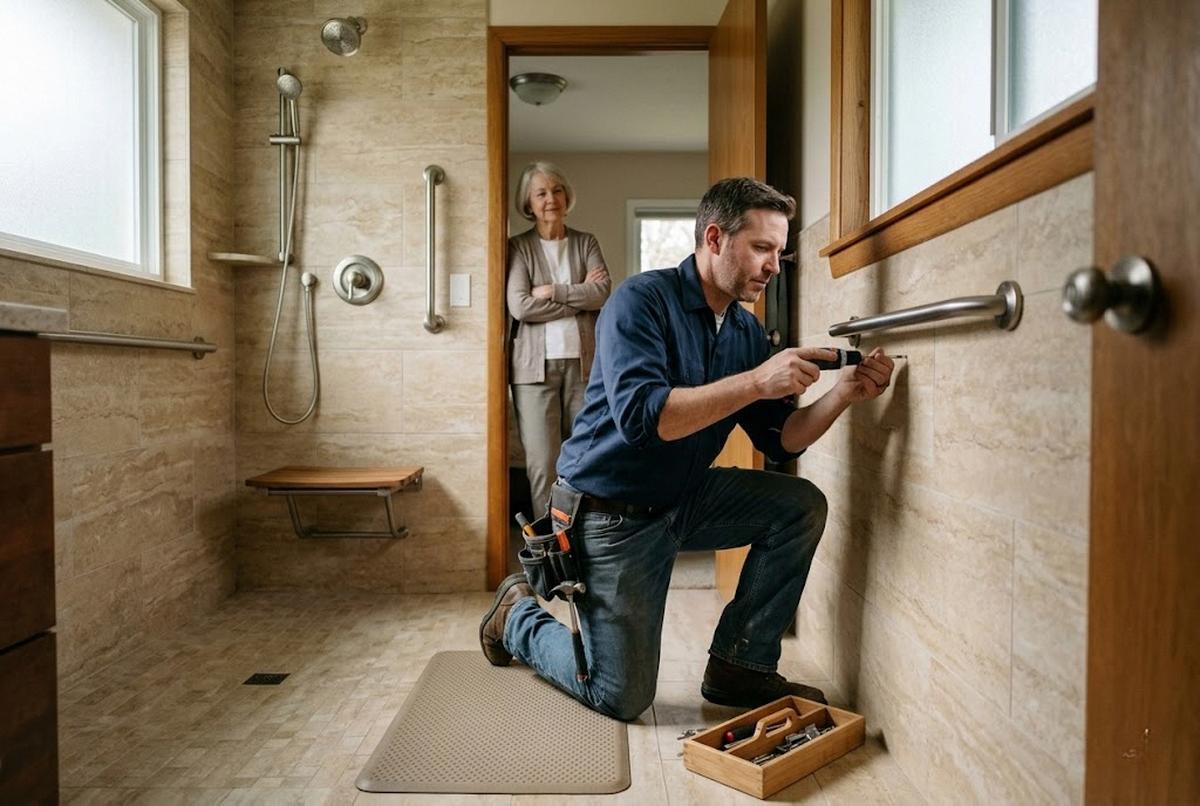
- Grab bars in bathrooms and hallways
- Wheelchair ramps (permanent and portable)
- Widened doorways (standard is 32 inches; wheelchair-accessible is 36)
- Walk-in showers or roll-in showers replacing bathtubs
- Stairlifts and porch lifts
- Non-slip flooring
- Lever-style door handles and faucet handles
- Raised toilets
- Improved lighting in hallways and stairwells
- Handrails on both sides of stairs
Usually not covered:
- General renovation or remodeling
- Landscaping
- Appliance upgrades (unless medically necessary)
- Cosmetic repairs
The line between "modification" and "repair" matters. A leaky roof is a repair. A ramp to the front door is a modification. Some programs cover both. Most don't.
Federal Grants: The Big Three You Should Know
Three federal programs fund home modifications for seniors, and each one works differently. I'm going to break them down with actual numbers because the vague "financial assistance may be available" language on government websites helps nobody.
1. USDA Section 504 Home Repair Program
This is the one most people haven't heard of, and it's the most straightforward grant for seniors.
What it gives you: Up to $10,000 in grant money — lifetime cap, not annual. If your home is in a presidentially declared disaster area, the cap increases to $15,000. There's also a loan component of up to $40,000 at 1% interest for 20 years, but the grant portion is what matters here because grants don't get repaid.
Who qualifies:
- You must be 62 or older
- Your household income must be at or below 50% of your county's Area Median Income (that's the "very low-income" threshold)
- You must own and occupy the home
- The home must be in an eligible rural area (and "rural" is broader than you think — towns up to 35,000 people often qualify)
- You cannot be able to obtain affordable credit elsewhere
How to apply: Contact your local USDA Rural Development office. You can find yours at rd.usda.gov or by calling 1-800-670-6553. Applications are accepted year-round, but funding runs out, so apply early. You'll need proof of ownership, income documentation, and a description of the repairs needed.
Wait time: Varies wildly by state. I've seen reports of 30 days in some rural counties and 6+ months in others. Call your local office and ask directly — they'll tell you.
Actually, I need to correct something. The income limits aren't a flat number — they vary by county and household size. A single senior in rural Michigan might qualify with an income under $31,550, while the same senior in a higher-cost county could qualify at $38,000 or more. Check the USDA income eligibility calculator at eligibility.sc.egov.usda.gov.
2. HUD's Older Adult Home Modification Program
HUD announced $30 million in grants specifically for home modifications for older adults. This money flows through local nonprofits and housing agencies — you don't apply to HUD directly.
What it covers: Accessibility modifications, safety improvements, and the assessments that determine what you need. No cost-sharing or matching funds required from the homeowner.
How to access it: Contact your local HUD-approved housing counseling agency. Find one at hud.gov/counseling or call 1-800-569-4287. They'll know which organizations in your area received funding.
3. Community Development Block Grants (CDBG)
Cities and counties receive CDBG funds from HUD and can allocate portions to senior home modification programs. The amount and availability depends entirely on your local government's priorities.
How to find out: Call your city or county's community development department. Ask: "Do you have CDBG-funded home repair or modification programs for seniors?" Some cities, like Dallas, offer up to $10,000 in grants through these funds.
VA Housing Grants for Veterans
If your parent served in the military, pay attention. The VA offers some of the most generous home modification funding available, and too many veteran families don't know about it.
My father served four years in the Navy. When his health declined, I spent months untangling the VA benefits system — twenty-six pages of application for Aid and Attendance alone, his DD-214 buried in a basement filing cabinet between a stack of old tax returns and a folder of expired insurance policies. But the benefits, when they came through, were real. The home modification grants work the same way: worth the effort, if you can survive the paperwork.
Specially Adapted Housing (SAH) Grant: Up to $126,526 for fiscal year 2026. This is for veterans with permanent, total service-connected disabilities. You can use it up to 6 times over your lifetime. Apply through VA Form 26-4555.
Special Housing Adaptation (SHA) Grant: Up to $25,350 for FY2026. For veterans with specific service-connected disabilities including blindness or loss of upper extremities.
Home Improvements and Structural Alterations (HISA) Grant: This is the one most accessible to a wider range of veterans.
- Up to $6,800 for veterans with any service-connected disability
- Up to $2,000 for veterans with non-service-connected disabilities only
Temporary Residence Adaptation (TRA) Grant: Up to $50,961 (SAH-eligible) or $9,100 (SHA-eligible) for modifications to a family member's home where the veteran is temporarily living.
How to apply: Start at va.gov/housing-assistance/disability-housing-grants/ or call 1-800-827-1000. For the HISA grant specifically, you'll need a prescription from a VA physician detailing the modifications your home requires. The VA aims to decide within about 30 days of a complete application, but gathering the medical documentation and contractor estimates beforehand — and completing the work and payment afterward — usually stretches the whole process to a few months. Plan for longer.
Medicaid HCBS Waivers: The Program Nobody Tells You About
I was sitting in a plastic chair at the county aging services office — number 47, they were on number 31 — when the woman next to me mentioned Medicaid paid for her mother's bathroom renovation. Grab bars, walk-in shower, the works. I looked at her like she'd told me water was free. "Medicaid covers home modifications?"
It does. Through Home and Community-Based Services (HCBS) waivers.
Here's how it works. Medicaid waivers allow states to provide services that help people stay in their homes instead of moving to nursing facilities. Home modifications fall under "Environmental Accessibility Adaptations" in most state waiver programs. The logic is sound: a $3,500 bathroom modification is far cheaper than $7,000 a month in a nursing home, and most seniors would rather stay home anyway.
The catch: Every state runs its program differently. Coverage limits, eligible modifications, and wait lists vary dramatically.
How the limits work:
- Colorado, for example, allows up to $10,000 in home modifications over a five-year waiver period
- Other states set their own caps. Some limit home modifications or assistive technology to a few thousand dollars per year; others fold equipment, technology, and modifications into a single combined spending category
- These limits change and differ by waiver, so confirm the current cap for your state and your specific waiver with your Medicaid office before you plan a project
Who qualifies: You must be enrolled in Medicaid, and your state must offer home modification benefits through an HCBS waiver. Income and asset limits for Medicaid vary by state, but generally, a single person must have income below $2,982/month and assets under $2,000 (though limits vary widely — Michigan's is $9,950, and several states have eliminated asset tests entirely).
How to apply: Call your state's Medicaid office or your local Area Agency on Aging. In Michigan, call the Medicaid Beneficiary Help Line at 1-888-642-4845. Every state has different forms and processes, but your AAA can walk you through it.
Warning: Many HCBS waiver programs have wait lists. Some states have wait lists of 2–3 years. Apply as early as possible, even if you don't need modifications yet.
State Programs Worth Checking
Beyond federal programs and Medicaid, most states run their own home modification assistance. These change frequently, so call to verify before you count on anything. But here's what's available as of early 2026 in five major states.
Michigan: MSHDA offers low-interest home improvement loans up to $25,000 for accessibility modifications, including ramps, grab bars, and doorway widening. Separately, the MI-HOPE program provides grants for energy-related exterior repairs like roofs and furnaces, though funding cycles close quickly. Contact MSHDA at 517-373-8370 or visit michigan.gov/mshda for current program availability.
New York: The RESTORE (Residential Emergency Services to Offer Home Repairs to the Elderly) program provides up to $20,000 per project in grants for emergency home repairs and modifications for homeowners 60+. Administered through local nonprofits. Also check the Older Adult Home Modification Program through your local AAA.
Florida: The State Housing Initiatives Partnership (SHIP) program distributes funds to all 67 counties for housing assistance, including home modifications for seniors. Amounts vary by county. Contact your county's SHIP administrator — find yours at floridahousing.org.
Texas: Dallas offers a senior home repair program providing up to $10,000 in grants. Houston's Minor Home Repair Program serves seniors 62+. Other cities have similar programs. Start with your city's housing department or 2-1-1 Texas.
California: Most home-modification help here comes through city- and county-level programs. Los Angeles, for example, runs a Handyworker Program for low-income homeowners 62+. Contact your local Area Agency on Aging for the most current programs.
For every other state: Call 211. That three-digit number connects you to your local information and referral service, and they maintain databases of every assistance program in your area.
Nonprofits That Actually Show Up
My mother's neighbor, Tita Ging, told me over merienda one afternoon that a group of volunteers had built a ramp to her friend's front door for free. "They just came on a Saturday and built it," she said, waving her hand like people do this all the time. "No charge. Aling Nena couldn't believe it."
That was Rebuilding Together, and they're not the only nonprofit doing this work.
Rebuilding Together (rebuildingtogether.org): The largest national nonprofit focused on home repairs and modifications. Three programs: Safe at Home, Heroes at Home (veterans), and National Rebuilding Day. They provide free labor and materials for low-income homeowners, with seniors and veterans prioritized. Application windows vary by affiliate — Rebuilding Together Minnesota, for example, accepts applications January through March and October through March. Find your local affiliate on their website.
Habitat for Humanity Aging in Place (habitat.org/our-work/aging-in-place): Many local Habitat affiliates run Aging in Place programs that install grab bars, ramps, lever handles, and other mobility aids. To qualify: age 62+, own and occupy the home, income below 80% AMI. You'll need to contribute 2–8 hours of "sweat equity" — light volunteer work that supports Habitat's mission. Contact your local affiliate directly.
Christmas in Action / local church-based programs: Many communities have volunteer groups that do home modifications on specific service days. Your Area Agency on Aging will know who's active in your area.
Lions Club, Rotary Club, Kiwanis: Local service organizations sometimes fund accessibility projects. Worth a phone call.
The Tax Angle Most People Miss
Even if you don't qualify for a grant, you may be able to deduct home modification costs on your federal taxes. Most people don't know this.
Under IRS rules, home modifications that are medically necessary qualify as medical expenses on Schedule A of Form 1040. Grab bars prescribed by a doctor, a ramp for wheelchair access, a stairlift recommended by an occupational therapist — these can all count.
The key rules from IRS Publication 502:
- You can only deduct expenses that exceed 7.5% of your Adjusted Gross Income (AGI)
- You must itemize deductions (not take the standard deduction)
- If the modification increases your home's value, you can only deduct the cost that exceeds the value increase. A $4,500 walk-in shower that adds $2,000 to your home's value? You can deduct $2,500
- You need documentation: a doctor's letter stating medical necessity, receipts, and proof of payment
Get IRS Publication 502 at irs.gov/pub/irs-pdf/p502.pdf or call 1-800-829-3676 to request a print copy.
Talk to a tax professional before claiming these deductions. Seriously. The rules around what counts as "medically necessary" versus "personal improvement" are specific, and getting it wrong means an audit you don't want.
How to Apply: Step by Step
The application process is where most people give up. Too many forms, too many offices, too much waiting. I get it. When I helped my parents with the VA benefits application, it took seven months and about forty hours of my time across calls, forms, and follow-ups. But the money came through, and it mattered.
Here's the process I'd follow if I were starting from scratch today.
Step 1: Get a home assessment. Before you apply for anything, get an occupational therapist or certified aging-in-place specialist to evaluate the home. Many Area Agencies on Aging offer free home safety assessments. This gives you a prioritized list of modifications and the professional documentation that grant programs require. Call the Eldercare Locator at 1-800-677-1116 or visit eldercare.acl.gov to find your local AAA.
Step 2: Document everything. Gather these before you start any application:
- Proof of homeownership (deed or tax records)
- Income documentation (Social Security statements, tax returns, pension statements)
- A doctor's letter stating the medical necessity of modifications (be specific — "patient requires grab bars due to fall risk" is better than "patient needs home modifications")
- Photos of current conditions
- For veterans: DD-214 discharge papers
- For Medicaid: proof of enrollment
Step 3: Apply to multiple programs simultaneously. Don't apply to one, wait, get denied, then try another. Apply to everything you qualify for at the same time. Programs can stack — you might get $10,000 from USDA, $5,000 through a Medicaid waiver, and have Rebuilding Together install grab bars for free. That's allowed.
Step 4: Follow up every two weeks. Government programs don't call you back. You call them. Set a reminder on your phone. Call, ask for a status update, write down the name of whoever you spoke to and the date. Keep a folder — physical or digital — of every form, confirmation number, and contact.
Step 5: Get help if you need it. Your Area Agency on Aging often has caseworkers who will help you fill out applications. HUD-approved housing counselors do this for free. You don't have to do it alone. Knowing how much aging in place actually costs helps you figure out which programs to prioritize.
What to Do When You Get Denied
You will probably get denied at least once. Not because you don't qualify, but because a form was incomplete, or funding ran out, or your income was $200 over the limit in a specific quarter.
Don't stop there.
Read the denial letter carefully. It should state the reason. If it's a documentation issue, fix it and reapply. If it's income, ask about the appeals process — some programs have hardship exceptions.
Appeal. Most federal programs allow appeals. The USDA Section 504 program has a formal appeal process through your state Rural Development office. VA denials can be appealed through the Board of Veterans' Appeals. Medicaid denials can be appealed through your state's fair hearing process.
Try a different program. The USDA said no? Try your state program. State program has a wait list? Try a nonprofit. There are enough programs out there that a denial from one doesn't mean the end.
I've been through this with my parents' insurance. A $2,200 bill that should have been covered, denied as "not medically necessary." I filed an appeal with a letter from the cardiologist. Six weeks later: covered in full. The system rewards persistence. It shouldn't, but it does.
Ask your AAA caseworker for alternatives. They know every local program, including ones that don't show up on Google. Church groups, community foundations, local government emergency funds — your caseworker has a list.
Putting It All Together
If you're reading this because you're worried about a parent, I know the feeling. My mother pointed at a hallway and mentioned she almost fell, and three weeks later I had a spreadsheet open with twelve grant programs and four phone numbers circled. The system for getting help with home modifications for seniors exists, but it's scattered and confusing and assumes you have time to figure it out.
So here's your starting point. One phone call, this weekend.
Call the Eldercare Locator: 1-800-677-1116. Tell them your zip code and say you need help with home modifications. They'll connect you to your local Area Agency on Aging, and that caseworker will know every federal, state, and local program you qualify for. One call. That's step one.
From there, you can apply to the USDA Section 504 program (if you're in a rural area), check your state's programs, call the VA (if your parent served), look into Medicaid HCBS waivers, and reach out to Rebuilding Together or Habitat for Humanity.
No one program covers everything. But stacked together — a federal grant here, a Medicaid waiver there, a nonprofit installing grab bars on a Saturday — you can make a home safer without draining your savings or your parent's savings. And that matters more than I can put into words, because the alternative is a conversation about moving to a care facility that nobody wants to have before they have to.
I'm still working on my parents' house. The ramp is done. The grab bars are up. The shower is next. It's slow, and the paperwork is a slog, and I've been on hold with more agencies than I can count. But every modification buys my mom more time in the home she loves, in the backyard where she grows her tomatoes and Thai chilis and tells me to take my shoes off.
If you're in this fight, you're not alone. And you don't have to figure it out by yourself.
Quick Reference: Phone Numbers and Websites
| Resource | Phone | Website |
|---|---|---|
| Eldercare Locator (AAA finder) | 1-800-677-1116 | eldercare.acl.gov |
| USDA Rural Development | 1-800-670-6553 | rd.usda.gov |
| HUD Housing Counseling | 1-800-569-4287 | hud.gov/counseling |
| VA Benefits | 1-800-827-1000 | va.gov/housing-assistance |
| Medicare / Medicaid | 1-800-633-4227 | medicare.gov |
| 211 (Local resources) | 2-1-1 | 211.org |
| Rebuilding Together | (varies by affiliate) | rebuildingtogether.org |
| Habitat for Humanity | (varies by affiliate) | habitat.org |
| IRS (Publication 502) | 1-800-829-3676 | irs.gov |
| MSHDA (Michigan) | 517-373-8370 | michigan.gov/mshda |