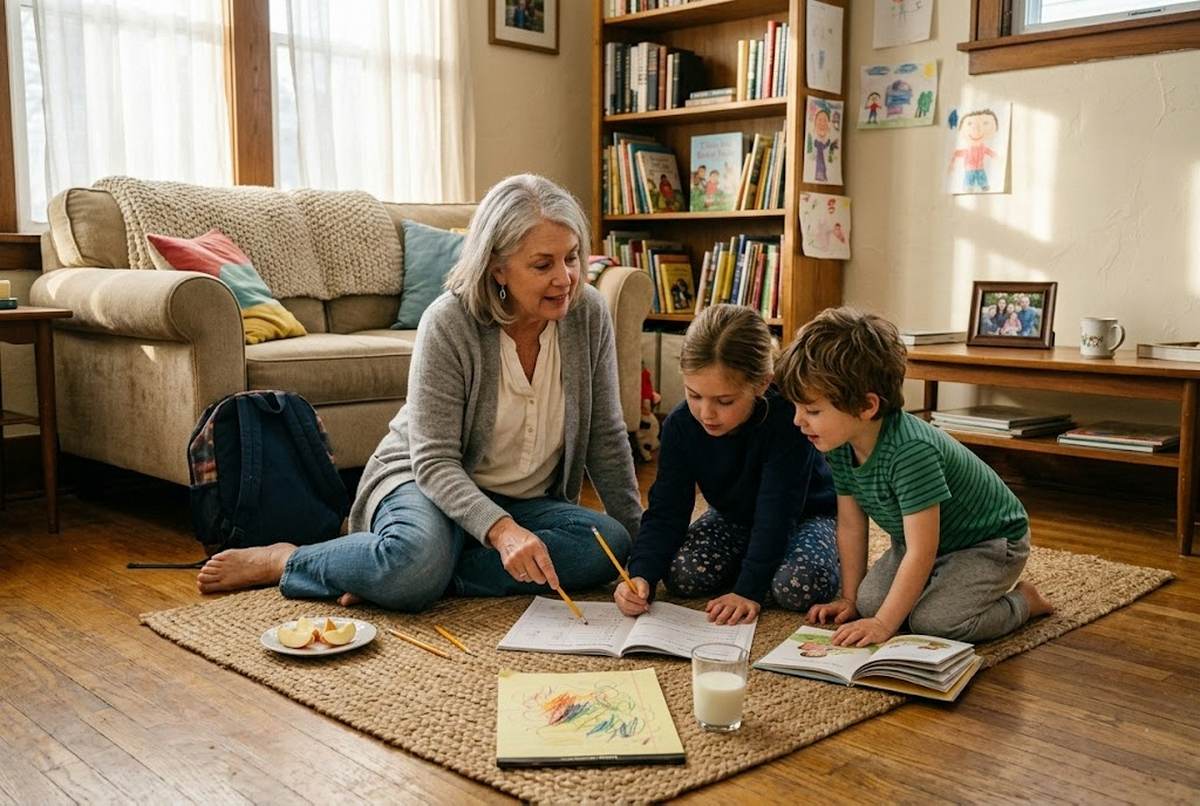
The phone rang on a Thursday evening, just past seven. I was rinsing clay off my hands after pottery class, still wearing my apron, when Cecelia's name lit up my screen. She'd been coming to Seasons of Grace for about six months by then, a retired postal clerk from Swannanoa with a quiet laugh and reading glasses she was always losing. But her voice that night wasn't quiet. Her daughter had entered a treatment facility in Charlotte, and Cecelia's two grandchildren, ages four and nine, were standing in her living room with garbage bags full of clothes.
"Eleanor, I have a two-bedroom apartment," she said. "I don't even have a bed for them."
I hear versions of this call more often than most people would guess. A grandparent's life rearranges itself in a single evening. The retirement they'd planned around morning walks and library books suddenly involves school pickups, pediatrician appointments, and the bewildering question of where, exactly, everyone is going to sleep.
Grandfamily housing exists to answer part of that question. Not all of it. But a critical part, the part about having a safe, affordable, right-sized place to land when you're sixty-seven years old and raising children again. If you're in that situation, or if you love someone who is, I want to walk through what's available, how to find it, and what financial and legal steps can make the path a little less steep.
What a Grandfamily Is (And Why the Word Matters)
The term is newer than the reality. Grandparents have always stepped in. But "grandfamily" finally gave a name to households where grandparents or other older relatives are raising children without the parents in the home. Generations United estimates that more than 2.4 million children live in these families, raised by grandparents, other relatives or close family friends with no parent in the home. (Its 2019 housing report used an earlier estimate of 2.65 million.)
Why does the label matter? Because without a name, these families were invisible to the systems built to help them. Senior housing said: no children allowed. Family housing said: you don't qualify as a parent. Grandfamilies fell through a gap so wide you could lose a whole household in it.
Generations United, the nonprofit that has done the most sustained work on this issue, uses the term specifically to push for policy changes. A named problem gets funding. An unnamed one gets sympathy and not much else.
The Housing Gap Nobody Designed For
Have you ever tried to fit a car seat into a two-door coupe? That's roughly what it feels like to find housing as a grandparent raising grandchildren. The infrastructure wasn't built for you.
Most affordable senior housing developments, including those funded through HUD's Section 202 program, were designed for adults 62 and older living independently. Children aren't part of the model. The apartments are one-bedrooms. The common areas are quiet. The leases sometimes explicitly prohibit minors from residing on the premises.
On the other side, public housing and family-oriented developments assume a younger head of household. The application forms ask about employment income, not Social Security. The playground might be there, but the grab bars and first-floor units aren't.
A woman I sat with at a caregiver burnout workshop two winters ago told me she'd been denied by three different housing complexes in Buncombe County. One said her granddaughter couldn't live in a senior building. Another said her income, which was Social Security plus a small pension from the Biltmore Estate, was too high for family housing but too low for market rate. The third had a two-year waiting list. She was sleeping on a pull-out sofa in her own living room so her grandchildren could have the bedroom.
That in-between space, too old for one system and too young for another, is where grandfamilies live. And for years, almost nobody was building for them.
Actually, that's not quite right. A few people were. They just didn't get much attention until recently.
Grandfamily Housing: What It Actually Looks Like
The first purpose-built grandfamily housing in the country opened in 1998 in Boston. GrandFamilies House, developed by Boston Aging Concerns — Young and Old United (BAC-YOU), was a 26-unit affordable housing complex designed specifically for grandparents raising grandchildren. The apartments had two, three and four bedrooms, and the building offered on-site support services. It was revolutionary, and for a long time, it was nearly alone.
Today the Grandfamilies & Kinship Support Network lists about two dozen housing developments across the country built for or serving grandfamilies. That's not many! But each one offers a blueprint for what works.
Villard Square in Milwaukee has 47 apartments for families where grandparents are the primary caregivers, on three floors above a branch of the Milwaukee Public Library. In Phoenix, Grandfamilies Place of Phoenix offers 56 two- and three-bedroom apartments with support services. In New York's South Bronx, the GrandParent Family Apartments, the first building constructed from the ground up for grandfamilies (2005), has 50 two- and three-bedroom apartments, rents set at 30 percent of adjusted income, and on-site after-school programs and case management.
What these places share matters more than what makes them different. They all provide:
- Apartments sized for multigenerational families, not studio-dwelling retirees
- Income-based rents, usually pegged to 30% of gross income
- On-site supportive services: counseling, tutoring, legal aid referrals, parenting resources
- A community of peers, other grandparents doing the same hard, beautiful thing
The peer community piece is one nobody talks about enough. Cecelia, the woman from Swannanoa I mentioned earlier, told me six months after she moved into a grandfamily-style apartment complex outside Hendersonville: "I stopped feeling like I was the only person in the world doing this." That sentence carries more weight than any policy brief.
How to Find Grandfamily Housing Near You
The honest answer is that it takes work. About two dozen developments serving a nation of 2.4 million children in grandfamilies means the math is brutal. But options beyond purpose-built housing exist, and knowing where to look makes a real difference.
Start here:
- Grandfamilies.org (run by Generations United and the ABA Center on Children and the Law): A searchable database of state laws and policies that affect grandfamilies, including a housing section. The list of housing developments built for grandfamilies is on the Grandfamilies & Kinship Support Network site, gksnetwork.org
- GrandFacts State Fact Sheets (available at gksnetwork.org/grandfacts-fact-sheets): Funded mainly by the Brookdale Foundation Group in partnership with Casey Family Programs, with additional support from AARP and others, these sheets list key programs, public benefits, legal relationship options and laws for your state. Bookmark yours
- Your local Area Agency on Aging (AAA): Call the Eldercare Locator at 1-800-677-1116 and ask specifically about grandfamily or kinship housing. Many AAAs have kinship navigator programs that can connect you directly to openings
- 211: Dial 2-1-1 from any phone. Ask for kinship care housing resources in your county
- Generations United (gu.org): Their report "A Place to Call Home" (2019) profiles the specialized grandfamily housing programs that existed then, at least 19, and recommends building a toolkit for communities that want to build more
If there's no purpose-built grandfamily housing near you, don't stop. Ask your local public housing authority (PHA) whether it gives kinship families any preference for Housing Choice Vouchers. And know that under the federal Fair Housing Act, a grandparent raising a grandchild with the parent's written permission counts as a family, even without legal custody.
Financial Help You May Not Know About
The money piece is where I've watched the most grandparents struggle, and where the most help goes unclaimed because people simply don't know it exists.
TANF Child-Only Grants. Every state offers Temporary Assistance for Needy Families child-only grants, and here is the part most grandparents miss: your income as the caregiver usually doesn't count. Eligibility is based on the child's income, which is almost always zero. The amounts vary painfully. The national average was $328 a month for one child in 2023, with only slight increases for additional children. Not enough. But not nothing, either, and many grandparents never apply because they assume their Social Security disqualifies them.
Kinship Foster Care Payments. If the children entered your care through the child welfare system, you may be eligible for foster care payments, which are significantly higher than TANF grants. Rates are set by each state or county, so ask the caseworker for your state's monthly rate. This requires licensure as a foster parent, which involves a home study, background checks, and training hours. It's a process, yes. But the financial difference is substantial.
SSI for Grandchildren. If a grandchild has a disability, they may qualify for Supplemental Security Income regardless of the caregiver's income. The federal SSI payment in 2026 can reach $994 a month for a qualifying child.
Housing Choice Vouchers (Section 8). Grandfamilies absolutely qualify. Adding grandchildren to your household can increase your voucher amount and, in some jurisdictions, move you up the priority list. Contact your local PHA. Wait lists are long, often years, but some PHAs have expedited processing for kinship families. Put your name on the list today even if the wait feels impossible.
Medicaid and CHIP. Your grandchildren almost certainly qualify for Medicaid or the Children's Health Insurance Program. In most states, enrollment is straightforward and not tied to your legal custody status.
I have seen grandparents leave thousands of dollars on the table because they didn't know these programs existed, or because they assumed their own retirement income made them ineligible. It usually doesn't.
The Legal Piece: Custody, Guardianship, and What Housing Programs Require
A retired teacher named Willard came to one of our Tuesday circles last spring and said something that silenced the room: "I've had my grandson for two years and I still can't enroll him in school without begging." He didn't have legal custody. He had a child sleeping in his spare bedroom and no paperwork to prove the arrangement was anything more than a long visit.
This is where helping a parent who refuses help meets the bureaucratic machinery of housing, schools, and benefits. Without some form of legal relationship, doors stay closed.
The three main options:
1. Temporary or emergency custody. Granted by a family court, often quickly, when a child's safety is at stake. This is enough for school enrollment and medical consent in most states. Some housing programs accept it.
2. Legal guardianship. A more permanent arrangement. The court conducts an investigation of your physical, mental, social, and financial fitness. Parental rights are not terminated, but day-to-day authority transfers to you. Some housing programs and agencies ask for guardianship or custody papers, though under federal fair-housing law a housing authority should not require legal custody for a grandparent raising a child to count as a family. In many states, guardianship can be filed pro se, meaning without a lawyer, though I'd recommend legal aid if it's available.
3. Kinship foster care (formal). This goes through the child welfare system and provides the most financial support but the most oversight. Monthly home visits, required training, annual reviews. For some families, the structure is actually welcome.
Each state handles this differently. The GrandFacts fact sheets I mentioned earlier include state-specific legal options and links to free legal help. Grandfamilies.org also has a Kinship Legal Toolkit that walks through the options.
Don't let paperwork paralysis keep you from acting. Start with your county courthouse's family division or your state's legal aid hotline.
What Grandchildren Need (Besides a Roof)
The sound of a screen door closing. A regular bedtime. Cereal they picked out themselves at the Ingles on Tunnel Road. What grandchildren in grandfamilies need is smaller and more specific than any program description can capture.
But the programs try, and the good ones get close.
The best grandfamily housing developments offer after-school tutoring, summer enrichment activities, mental health counseling for children processing separation from their parents, and connections to Big Brothers Big Sisters or similar mentoring programs. Some provide on-site child care, which matters enormously when the grandparent caregiver is sixty-eight years old and exhausted by 3 PM. If you're in that position, respite care can also provide temporary relief while you recharge.
After all these years, the thing I keep returning to is that the children need one thing above everything else: to see their grandparent not drowning. A child who watches their grandmother cry on the phone to the electric company every month absorbs that stress in their bones. A child who sees their grandfather feeling less alone, connected to other adults who understand, breathing a little easier, absorbs that too.
This is why grandfamily housing is not just about square footage. It's about wrapping the whole household in something sturdy enough that the grandparent can stop surviving and start creating a home that feels like home.
When the House Becomes Something More
One more thing, and then I'll let you go. Last month I drove down to Hendersonville to visit Cecelia. Her apartment is small. Two bedrooms, a galley kitchen, a balcony with a plastic chair and a pot of rosemary the nine-year-old grew from a cutting. The four-year-old, Janelle, was sitting on the living room floor surrounded by crayon drawings of what appeared to be purple horses.
Cecelia poured me coffee in a mug that said "World's Best Grandma" in chipped gold letters. She sat down across from me and said, "You know what nobody tells you? The hard part isn't the housing. The hard part is believing you're allowed to ask for help."
She's right. We come from a generation that handled things quietly. We figured it out. We made do. But making do with two children sleeping on an air mattress in your living room while you're drawing Social Security and paying for their school supplies out of a checking account that wasn't built for this — that isn't strength. That's a family in crisis that deserves every resource this country has built for exactly this moment.
So ask. Call the Eldercare Locator at 1-800-677-1116. Pull up your state's GrandFacts sheet. Walk into your county's Department of Social Services and say, "I'm raising my grandchildren and I need help with housing." Say it out loud! The words are harder than the paperwork, and the paperwork is hard enough.
If you're doing this work, you already know something most people learn only from living it: love is not a feeling. Love is showing up at the school open house when your knees ache and you'd rather be in bed. Love is learning to braid hair at sixty-three from a YouTube video. Love is the purple horse on the living room floor.
You are not alone in this. You were never supposed to be.