This morning on my walk along the Blue Ridge, the laurel was just starting to bud. Late March in Asheville, when winter hasn't quite let go but something green is pushing through anyway. My knees had their usual opinions about the first hill. I stopped at the overlook, caught my breath, and thought about a conversation I'd had the day before with a woman in my Seasons of Grace group.
She's seventy-one. A retired physical therapist, of all things. She started on Ozempic four months ago for her Type 2 diabetes, and the weight came off fast. Seventeen pounds in four months. Her doctor was pleased. Her A1C numbers looked better than they had in years. But she told me something her doctor hadn't mentioned. "Eleanor, I can't open jars anymore. My legs feel different on the stairs. I lost the weight, but I think I lost something else too."
She's not wrong. And she's not alone.
What GLP-1 Drugs Do, and What They Don't
GLP-1 receptor agonists, including semaglutide (sold as Ozempic and Wegovy) and tirzepatide (Mounjaro and Zepbound), work by mimicking a hormone in our bodies that regulates appetite and blood sugar. They're effective. Nobody disputes it. People lose significant weight, blood sugar stabilizes, and cardiovascular markers often improve.
But most conversations about these drugs leave out a critical piece: weight loss is not the same as fat loss. When we lose weight on any aggressive regimen, some of what goes is muscle. With GLP-1 drugs, the proportion is troubling. In the STEP 1 body-composition substudy, participants on semaglutide 2.4 mg lost about 6.9 kg of lean mass alongside 10.4 kg of fat — so roughly 40% of the weight lost was lean mass rather than fat. A 2024 review in Diabetes, Obesity & Metabolism, summarised by Endocrine News in 2025, puts the range wider still: 15% to 60%, depending on the patient and the drug.
Two things about that number matter more than the number itself. Lean mass is not muscle. It includes water, glycogen, organ and connective tissue as well as skeletal muscle, and a 2025 study found a meaningful share of the loss came from the liver. Forty percent of your weight loss being lean mass does not mean forty percent of it came off your legs. And the trials this comes from enrolled adults averaging around 46, with diabetes excluded. Dr John Batsis, whose team at UNC reviewed this literature, put the limitation plainly: few studies include participants over 60, and none focused on adults 65 or older. We are the population this research has not been done on.
For a thirty-five-year-old, losing some muscle during weight loss is recoverable. The body bounces back. For us — for anyone over sixty-five — the math is different.
The Muscle Problem Nobody's Talking About
I need to say something plainly, because I think it gets lost in the excitement around these medications. We are already losing muscle. Every one of us over sixty is.
Sarcopenia, the age-related decline in muscle mass and strength, begins around age thirty and accelerates after sixty. By some estimates, up to half of adults over eighty already have it. Our muscles are not what they were at forty, and every year the gap widens. This isn't failure. It's biology.
So when a seventy-year-old starts a GLP-1 drug and loses fifteen pounds of lean mass on top of what time has already taken, we're not talking about a cosmetic issue. We're talking about the difference between catching yourself when you stumble on a curb and ending up in the emergency room with a fractured hip. An editorial in the Annals of Internal Medicine warned these drugs may worsen sarcopenia in older adults. The researchers use the term "sarcopenic obesity" — excess body fat and low skeletal muscle at the same time. It is easy to miss, because the scale reads as a weight problem rather than a muscle problem. Roughly 28% of adults over 60 have it.
A man in my Tuesday wellness circle, a Korean War veteran, eighty-nine years old, started Ozempic last year without telling anyone in the group. He'd been a sergeant. The kind of man who wouldn't ask for help if the house was on fire. Carried his own groceries, mowed his own lawn, drove himself to every appointment. After three months on the medication, he'd lost twenty-two pounds. His pants were loose and he was proud of it. But one Tuesday he lowered himself into his chair and couldn't get back up without gripping the table. He looked at me and said, "Something's wrong with this chair." It wasn't the chair.
The confusion in his face, the pride still holding on, the refusal to name what was happening — it stays with me. Because he wasn't doing anything wrong by taking the medication. His doctor prescribed it. The weight loss was real, and for his diabetes, beneficial. But nobody had told him about the muscle piece. Nobody had said, "While this drug is working on your blood sugar, here's what you'll want to do to protect your strength."
Nobody told him what to watch for.
When Bones Enter the Picture
And it isn't only muscle.
New research is raising flags about bone density too. Researchers at the University of Pennsylvania looked at more than 146,000 adults and found about 4% of GLP-1 users developed osteoporosis against a little over 3% of non-users — roughly a 30% higher relative risk, but a one-percentage-point difference in absolute terms. Reported by NBC News in March 2026, with two caveats they gave that I am not going to bury: the work was presented at a conference and has not been peer reviewed, and being observational it cannot show the drugs caused anything.
On fractures, the study you will see quoted twice under two different names is one study: a Meir Medical Center cohort of more than 45,000 Israeli adults 65 and older with type 2 diabetes, presented at the 2025 World Congress on Osteoporosis and published in JCEM. The increase is real and modest — about 12% relative, measured against other diabetes drugs rather than against nothing — and here is the part that surprised me: it was significant in ages 65 to 75 and not in those over 75.
One correction to something I had wrong for a while. The fracture language people cite from "the FDA label for semaglutide" is on the Wegovy label, not Ozempic's. Ozempic's own label says no overall difference in safety between patients over 65 and younger adults.
The mechanism makes sense when you sit with it. Rapid weight loss means less mechanical load on the skeleton — bones need the stress of carrying weight to maintain density. When appetite drops as sharply as it does on these drugs, people often eat less protein, less calcium, fewer foods rich in vitamin D. The bones feel it.
For anyone who's had a preventive bone density scan recently, this data deserves a real conversation with your doctor. Not a two-minute check-in. A conversation.
The Face in the Mirror
Have you heard the term "Ozempic face"? It's all over the news, and I almost didn't include it here because it sounds trivial next to fracture risk. But I want to take it seriously for a moment, because how we see ourselves matters.
Rapid facial fat loss creates a hollowed, gaunt appearance. Temples, cheeks, jawline. Research suggests massive weight loss can make people look up to five years older in their faces. For older adults, reduced skin elasticity makes this more pronounced. You lose the weight you wanted to lose, and the person looking back at you in the mirror seems more fragile, not less.
This isn't vanity. It's identity.
What the Science Is Getting Right
Now for the part of this conversation giving me genuine hope.
Researchers know the muscle loss problem exists, and they're working on it. A Phase 2b clinical trial called BELIEVE, presented at the American Diabetes Association's 2025 conference and published in Nature Medicine in 2026, tested a drug called bimagrumab in combination with semaglutide. The results were striking. In 507 participants, lean mass fell by roughly 5% to 8% on semaglutide alone, against about 1% to 3% on the combination. Even more telling: 92.8% of total weight loss in the combination group came from fat, compared to 71.8% with semaglutide alone.
Bimagrumab isn't FDA-approved yet, and I want to be clear about it. We can't ask our doctors for it tomorrow. But the fact that researchers are specifically targeting the muscle loss problem means this conversation is moving in the right direction. The pipeline is promising. Actually, that's not quite right. The pipeline is necessary. Because without addressing the muscle question, GLP-1 drugs carry a risk for older adults that younger patients simply don't face.
Protein, Resistance, and the Practice of Showing Up
While we wait for the science to catch up, there are things we can do right now. And they work!
The Health ABC Study followed 2,066 adults aged seventy to seventy-nine and found those eating the most protein lost nearly 40% less lean mass over three years compared to those eating the least. At ENDO 2025 a small study — 40 adults, 23 of them on semaglutide, over three months, not yet peer reviewed — found older adults and women lost more muscle, and suggested protein may protect against it. It is the one piece of this research looking specifically at older adults, which is why I mention it, and it is far too small to settle anything. For seniors on these medications, the target is 1.2 to 1.6 grams of protein per kilogram of body weight daily. For a 150-pound person, roughly 82 to 109 grams of protein every day. Double what many of us actually eat.
What does this look like at the kitchen table? Two eggs at breakfast. Greek yogurt for a snack. A chicken breast or a piece of salmon at dinner. A handful of almonds in the afternoon. It adds up, but it requires intention, especially when the medication is suppressing your appetite and food doesn't sound appealing. My daughter Amara, who runs a counseling practice in Atlanta now, once asked me why I talk about protein like it's a spiritual practice. Because for seniors on GLP-1 drugs, it nearly is. Every gram of protein eaten is a small act of preservation, a way of telling your muscles you still need them.
Then there's resistance training. In a six-month single-arm study of 200 adults on semaglutide or tirzepatide, all supervised by an obesity physician and given resistance training and protein education, participants lost roughly 13% of body weight and only about 3% of muscle mass. No control group, and body composition measured by bioelectrical impedance rather than a DXA scan — encouraging rather than proven. CNN reported in August 2025 that strength training is key for GLP-1 users, particularly those over 65 — along with advice worth repeating: start at a lower intensity than you think you need, and build up slowly.
Lorraine, a retired mail carrier in my Seasons of Grace group, started resistance training with elastic bands after her doctor put her on Mounjaro. She was skeptical. Told me so right there in the community room, arms crossed, one eyebrow raised. "Eleanor, I walked twelve miles a day for thirty years. I don't need rubber bands." But her physical therapist had explained what the medication might do to her muscle mass, and Lorraine was nothing if not practical. She started with two sessions a week at her kitchen table, following along with a YouTube video her granddaughter had bookmarked. Six months in, her grip strength had actually improved, and she could haul her recycling bin to the curb without stopping halfway. "I still think it looks ridiculous," she told me, snapping the purple band against her wrist. "But my legs don't lie."
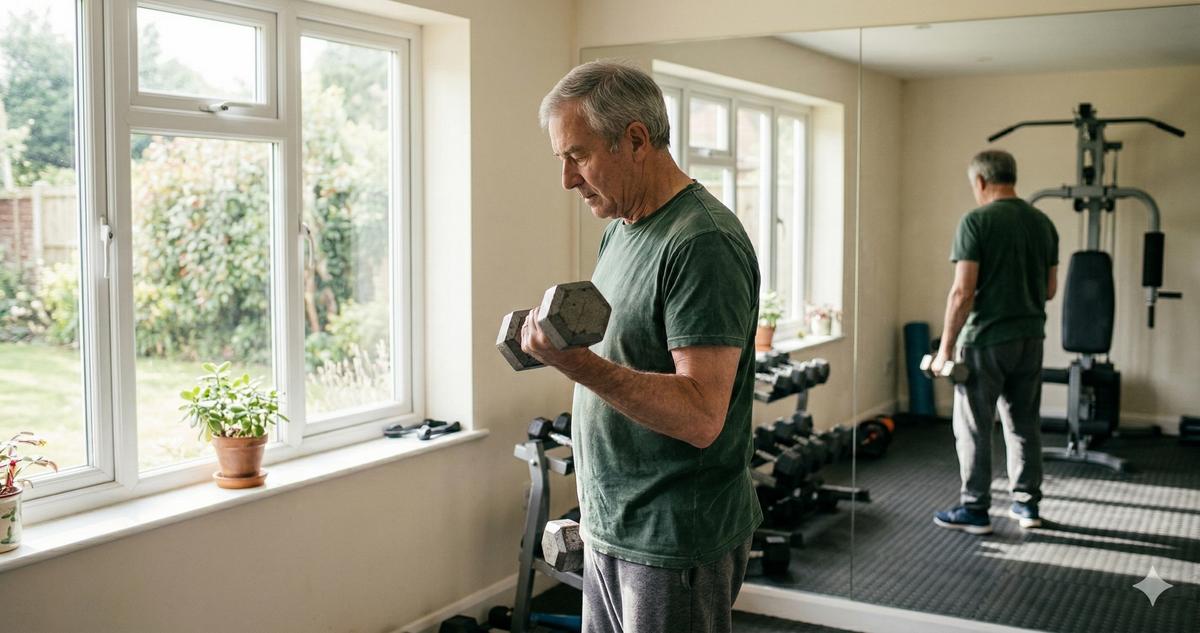
Two to three sessions a week. Not CrossFit. Not a gym membership if that's not your style. Resistance bands at the kitchen table, bodyweight exercises in the living room, a yoga practice modified for your body. The point isn't intensity — it's consistency. Showing up, even when you don't feel like it, even when the medication has taken the edge off your appetite and your energy feels low.
The Medicare Question
Money. We have to talk about it.
Medicare Part D cannot currently cover GLP-1 drugs for weight loss. Federal law prohibits it. If your doctor prescribes Ozempic or Mounjaro for Type 2 diabetes, Part D can cover it. Wegovy can be covered for cardiovascular risk reduction. But for weight management alone, you are paying cash — and the cash price moved a great deal after the November 2025 pricing agreements. Wegovy and Zepbound now run roughly $300 to $350 a month direct, rather than the $1,000-plus list prices quoted for years. Check the current number before you decide you cannot afford this. The figure in your head is probably out of date; mine was.
That has shifted, and it is worth getting the name right, because calling it the wrong thing at a pharmacy counter or on the phone with Medicare will get you nowhere. In December 2025 CMS announced the BALANCE Model — and alongside it, a separate short-term demonstration called the Medicare GLP-1 Bridge. The Bridge is the one actually running: it started July 1, 2026 and is scheduled to run through December 31, 2027, with eligible participants paying $50 a month. Two things to know before you count on it. Ozempic and Mounjaro are not on the list — the Bridge covers Foundayo, Wegovy, and the Zepbound KwikPen (not the single-dose Zepbound vials or pens), so if you are on Ozempic for weight management, this program does not reach your prescription. And the Bridge runs outside the normal Part D benefit, so that $50 does not count toward the annual out-of-pocket cap, your deductible does not apply, and Extra Help does not reduce it.
There are three ways to qualify, all based on your BMI when you started the drug rather than where you are today: 35 or higher on its own; 30 or higher with diastolic heart failure, uncontrolled high blood pressure, or chronic kidney disease at stage 3a or above; or 27 or higher with pre-diabetes, a prior heart attack or stroke, or peripheral artery disease with symptoms.
And two things rule you out: if your Part D plan already covers your GLP-1, or if you have Type 2 diabetes, moderate-to-severe sleep apnea, or fatty liver disease. That last group catches a lot of people reading this. If you are on Ozempic for diabetes, the Bridge is not your route — your Part D plan already is. If you do qualify and get turned away at the pharmacy anyway, our guide to what to do when the GLP-1 Bridge is denied walks through the fix.
As for BALANCE itself: states could begin joining on the Medicaid side as early as May 2026, though CMS has not published which ones have, and its Medicare Part D portion was delayed and is not currently scheduled.
The 2026 Part D out-of-pocket cap of $2,100 per year helps too. But the gap between what these drugs cost to age in place safely, including the protein, the training, the monitoring, and what Medicare actually covers remains wide. Ask your doctor. Ask your pharmacist. Know what you're walking into financially before you start.
Having the Conversation Your Doctor Needs to Hear
Last week, the retired physical therapist from my group sat down across from her endocrinologist with a list of questions she'd written on the back of a grocery receipt. She told me about it afterward, sitting on the bench outside our meeting room, late afternoon light coming through the dogwoods.
"I asked him about my muscle mass," she said. "He looked surprised. Like nobody had asked before."
That surprised look tells us something. Our doctors aren't withholding information out of carelessness. They're managing fifteen-minute appointments and dozens of patients and a medical system built for acute problems, not preventive conversations about body composition. Over the years, I've learned something about how medical conversations go — the doctor answers the questions you bring. So we have to bring better questions.
If you're on a GLP-1 medication, or considering one, ask about a body composition baseline. Not just your weight, but your lean mass. Ask about a DEXA scan for bone density. Ask what protein target makes sense for your body. Ask whether a referral to a physical therapist or exercise specialist could help you build a longevity-focused strength routine. These aren't aggressive questions. They're the right ones.
And if you're a family member helping a parent or spouse manage these medications, this is your conversation too. The weight of caregiving includes the weight of asking questions nobody else thinks to ask.
Don't wait for the next appointment to start. Write the questions down tonight. On a grocery receipt, if you want. It worked for her!
We Begin Where We Are
Our bodies have carried us through every season of this life. Through loss and love and mornings when getting out of bed was its own kind of courage. They deserve more than a prescription without a plan.
GLP-1 drugs may be the right choice for you. They may not. But if they are, walk into the choice with your eyes open and your muscles looked after. Eat the protein. Pick up the resistance band. Ask the uncomfortable question at your next appointment. And if you're already on these medications and nobody mentioned any of this — you're not behind. You're starting now.
The supplements and nutrition choices we make each day are small acts of faith in our own futures. So is this one.
You are not a number on a scale. You never were.