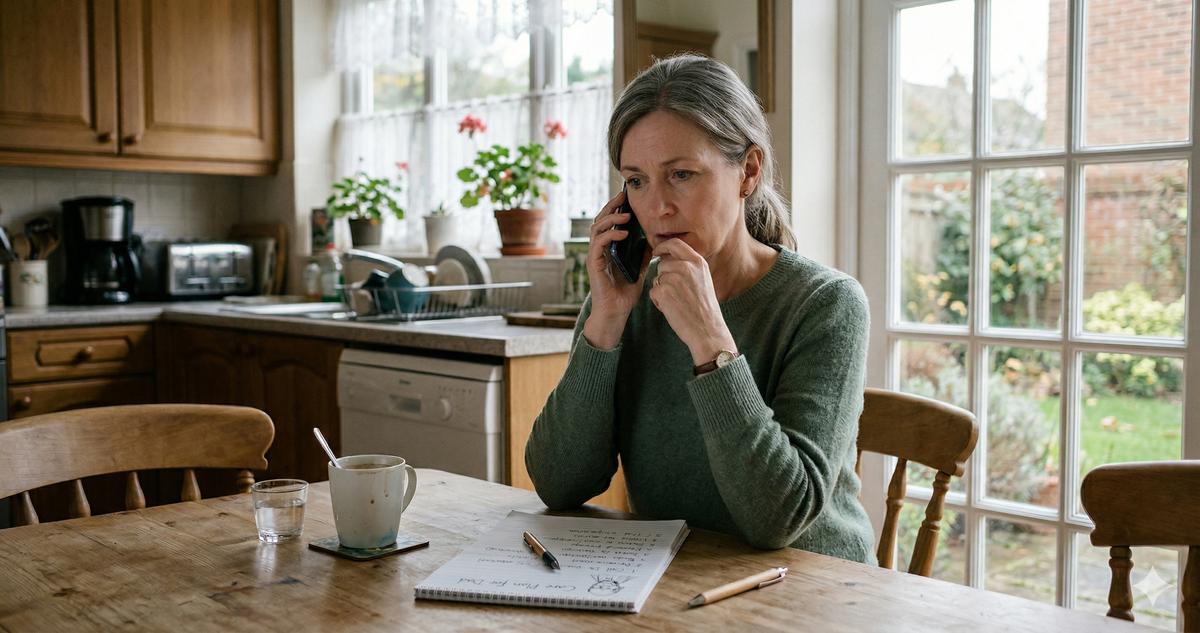
There is a particular quiet that comes over a phone call when your daughter is tired and trying not to sound it.
I have heard it in my own kitchen and I have heard it described to me, across a table, by more women than I could count. The call goes fine. She asks about the appointment. She says she'll look into the thing. And somewhere under it runs a current you can hear but not name, and you hang up and sit for a minute with your hand still on the phone.
Then you read a headline about the "sandwich generation," and you understand, with a drop in your stomach, that you are one of the two things doing the squeezing.
I want to spend some time with that, because there is a real study underneath the headline, and what it actually found is not what you are afraid it found.
What the Study Actually Says
The Pew Research Center published this on August 27, 2026, from a survey of 8,750 American adults. One thing to be careful about, and I only know it because I went and read the fine print under Pew's own charts: the survey itself was conducted in September 2025. Published this August, asked a year ago. And the fine print holds one more surprise, which I will come back to, because it changes what one of these numbers is allowed to claim.
Their definition is narrow and specific. A person is in the sandwich generation if they have a living parent aged 65 or older, and they have a child under 18 or have given financial support to a grown child in the past year.
Read that again and notice what it does not say. It does not say the parent needs care. It does not say the parent is ill, or dependent, or a burden. Having a living parent over 65 is the entire qualification on your side of it.
By that measure, a quarter of all American adults are in this situation. Among people in their forties, it is 54 percent — more than half. In their fifties, 45 percent. In their thirties, 25 percent.
So if your daughter is somewhere in her forties, the arithmetic is simply this: she is in the same position as most of the people her age. Not an unusual burden. The ordinary shape of a life in 2026.
The Number That Answers What You're Really Asking
Here is the finding I would put in front of every woman who has ever sat with her hand on a phone after a call.
Pew asked people how satisfied they are with their family life. Among adults in the sandwich generation, 48 percent said they were very satisfied. Among the adults who did not meet the definition, it was 43 percent.
They are more satisfied. Not less.
I read that number three times when I found it, because it runs against everything the word "sandwiched" is doing in that headline. The word suggests compression. Being squeezed between two weights. And the people actually living inside the definition report more satisfaction with their family life than the people outside it.
Here is the promised piece of fine print, and I would rather you heard it from me than found it under a chart later. That satisfaction question is not from the new survey at all. Pew asked it in October 2021 and carried the answers forward into this year's write-up; only the 54 percent and its companions come from 2025. Take a little off the number for that.
What it loses in freshness it repays somewhere I did not expect. Among people in their forties specifically — your daughter's exact bracket — the gap is not five points. It is 49 percent against 38 percent. Eleven points, and in the same direction.
And it is family life, precisely. Pew asked those same people about their social lives, their communities and their finances, and the sandwiched and the unsandwiched answered almost identically — 24 against 24, 25 against 24, 17 against 17. Nothing there. Whatever is happening, it is not that these are simply people with sunnier dispositions. The difference shows up in the one place the word "sandwiched" says it should not, and nowhere else.
Now let me be careful with you, because you deserve better than a comforting number handed over without its edges.
This is a survey taken at one moment in time. It cannot tell us that having an aging parent causes anyone to be more satisfied. It is entirely possible that the same closeness which makes a family satisfying is what puts an aging parent nearby in the first place — the causation could run the other direction, or both directions, or come from something neither of us has thought of. Nobody should tell you this proves your daughter is happy. The study does not know your daughter.
What it does defeat is the specific thing you have been telling yourself at night. I am ruining her life. Whatever is true of your family in particular, it is not true as a general fact that having an aging parent makes people's family lives worse. The data says something closer to the opposite, and it says it about a national sample of American adults rather than about anyone's particular kitchen.
That is not a promise. It is permission to stop assuming the worst.
I want to be plain about why I think this particular number matters so much. The fear you are carrying is not really a question about logistics. Nobody lies awake over who drives to the cardiologist. What keeps a person awake is the suspicion that their continued existence is subtracting something from a person they love — that the ledger has quietly gone into the red and everyone is too polite to say so.
A statistic cannot answer that about your family. But it can tell you that the ledger you have imagined is not the one most families are actually keeping. Asked across the country, the people with an aging parent in the picture were more likely to describe their family life as deeply satisfying. Whatever is being exchanged in those households, it is not running one direction only.
What This Cannot Tell You
I would be doing you a disservice if I stopped there.
Fifty-four percent of her age group being in the same position is a fact about longevity, not about your daughter's spare capacity. It tells you she is not alone. It does not tell you she has room.
And there is a way to misread all of this that would be worse than the fear it replaced: deciding that because the data looks reassuring, you should ask for nothing, arrange nothing, accept nothing. That is not what the number says. A tired daughter who loves you is still a tired daughter.
The honest position is smaller and steadier than either extreme. You are not a burden by existing. You may still need to make a plan.
Why It Is Your Generation That Made This
There is a detail in the study that almost nobody will write about, and I find it quietly moving.
Overall, the share of Americans in the sandwich generation has barely moved — 25 percent now, against 23 percent when Pew last measured it in 2021. Modest. Unremarkable.
But look at people in their fifties specifically. In 2021, 36 percent of them were sandwiched. Now it is 45 percent. That is a real jump in four years, and Pew explains it plainly: it is partly because more adults in their fifties now have a living parent aged 65 or older.
Sit with what that sentence means. The reason more fifty-somethings are caught between two generations is that their parents are still here.
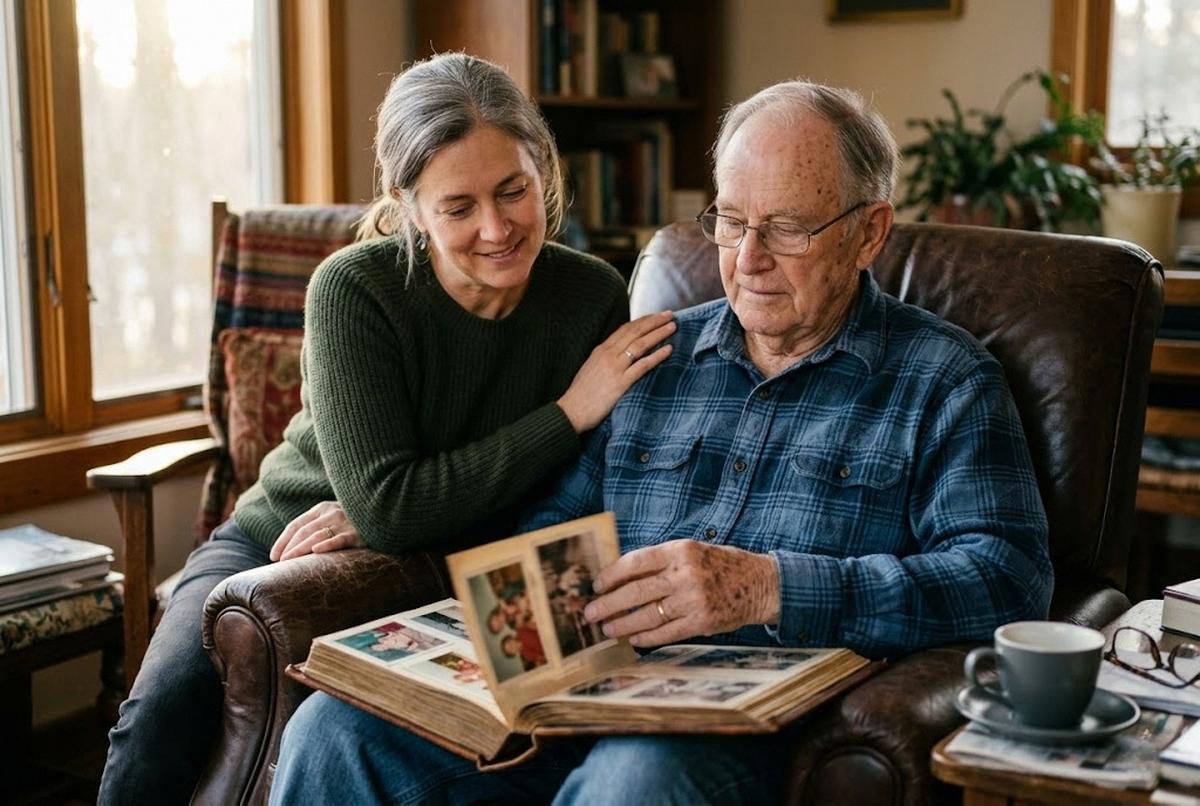
That is you. The rise in that number is not a measure of increasing burden. It is a measure of survival — of people who, a generation ago, would simply have been gone by now, and who are instead at the table, on the phone, at the Sunday dinner, complicating the calendar of a woman in her fifties who gets to still have a mother.
I do not think anyone should apologize for being counted in a statistic like that.
There is a version of this you may have lived through yourself. A great many women my age remember a grandparent who died at sixty-eight, or seventy-one, and remember it as unremarkable — sad, but the ordinary arithmetic of a life. I do not remember anyone in 1975 writing anxious articles about the strain of having a living mother at fifty-five, and I suspect that is because far fewer people were doing it.
The strain is real. I am not waving it away. But it is the strain of an outcome we spent a century trying to achieve, and it arrived without anyone updating the language we use for it. We got the extra years and we are still describing them with a word borrowed from a lunch counter.
It Is Not the Same Everywhere
One more thing from the study, and it changed how I think about the word "burden."
Being in the sandwich generation is not evenly spread across the country. Pew found it in 31 percent of Asian adults and 30 percent of Hispanic adults, against 23 percent of White adults and 21 percent of Black adults. It is also more common among people with at least a bachelor's degree — 30 percent, against 22 percent of those with some college or less — and it climbs with income: 32 percent of upper-income adults, 26 percent in the middle, 20 percent at the lower end.
I find those numbers clarifying. In a good many American families, a parent in her seventies living close to her children, folded into the week, consulted about things, is not a crisis that has befallen anyone. It is simply how a family is arranged, and it has been arranged that way for generations without anybody producing a worried headline about it.
The word "sandwiched" carries an assumption inside it — that the natural state of a grown woman is to have no one above her and no one below her, and that anything else is a squeeze. That assumption is not universal. It is one culture's default, dressed up as a finding.
You are allowed to belong to a family that never agreed with it.
What She'd Actually Want You to Ask
If the fear has been sitting with you, the useful thing is not to resolve it privately. It is to move it into the open, where two people can look at it.
Not "am I a burden?" — that question puts her in an impossible spot. There is only one answer she is allowed to give, and you will not believe it anyway.
Ask instead what would actually help. Specifically. Is the driving the hard part, or the phone calls with the insurance people? Would it be easier if I dealt with the pharmacy myself? What is the thing you keep meaning to ask me and haven't?
Those questions have real answers, and answering them is a relief rather than a test.
If the honest answer turns out to be that she is running low, that is information, not a verdict. It is worth both of you knowing the signs of caregiver burnout before either of you is deep into them, because the people who miss it are almost always the ones who assumed it could not apply to a family as close as theirs.
And there is a conversation worth having while it is still hypothetical rather than urgent — about what happens if you need more help than a phone call can deliver. Not because anything is wrong. Because the version of that conversation you have on a Tuesday afternoon, with nothing at stake, is a completely different conversation from the one held in a hospital corridor. Every family I have sat with has wished they had the Tuesday one.
And you might tell her the number. Forty-nine against thirty-eight. Tell her a national survey found that people in her exact situation report being more satisfied with their family life, not less. She has probably read the same frightening headline you did, from the other side of it.
The Hand on the Phone
I think about that quiet on the line, and I have come to believe it is usually not resentment. It is tiredness, which is a different thing entirely and a great deal more ordinary.
Fifty-four percent of the people her age are somewhere in the same week you are. Almost half of them, asked directly, say their family life is deeply satisfying — and in her forties, eleven points more than the people her age who are not in her position.
You are not the weight in that sentence. You are the reason there is a family in it.
Call her. Ask her the specific question. And when she says she is fine, believe about eighty percent of it — the same eighty percent she gives you when you say the same thing back.