My brother James called on a Wednesday, the way he has for thirty years, and I asked him to say it again.
Then I asked a third time.
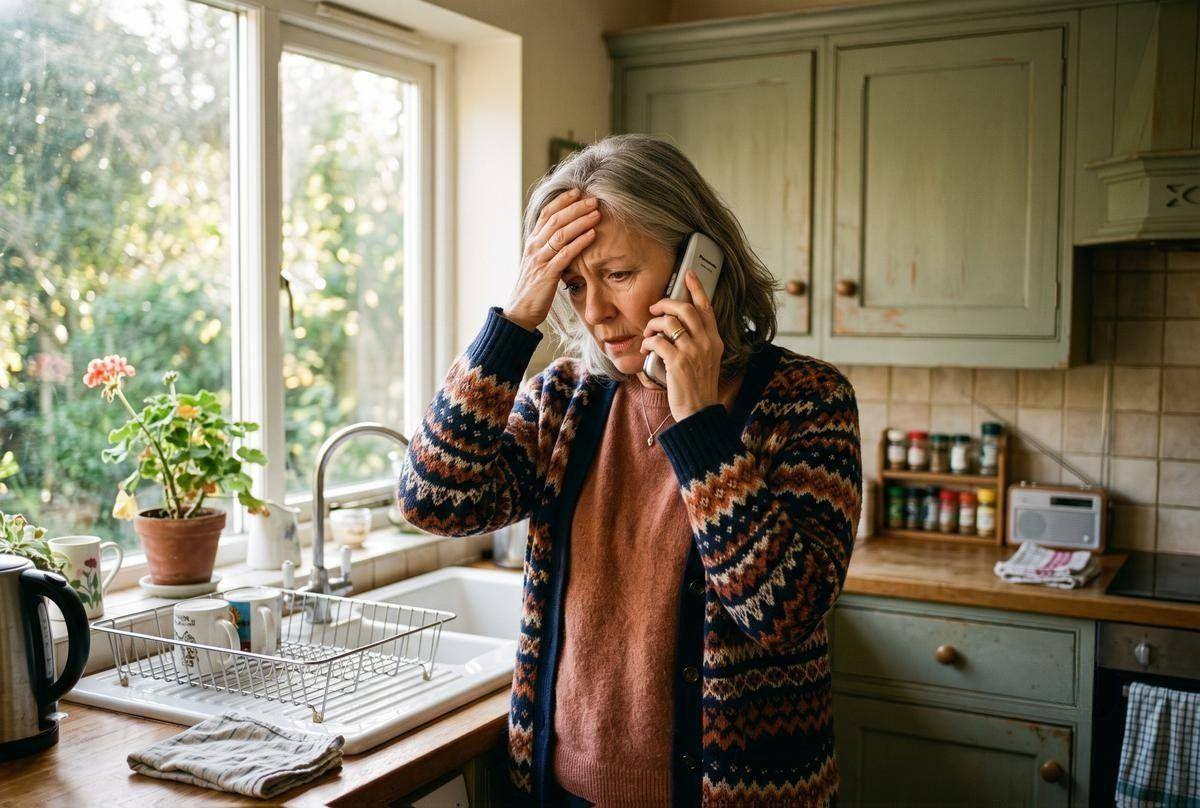
He was telling me something about the new mail carrier on his street in Savannah, nothing important, and I stood in my kitchen with the phone pressed hard against my ear and the refrigerator humming behind me and could not make out the shape of his sentence. James is seventy-two. He has never been a loud man. But this was something other than quiet. His voice had gone thin at the edges, the way a radio station thins when you're driving out of range of it, and halfway through that third repetition he laughed and said, "Never mind, Ellie. Wasn't worth saying twice."
That sentence stayed with me all week.
Because it was never about the mail carrier. It was about a man deciding, in real time, that his own words weren't worth the effort of being heard.
It Has a Name, and It Isn't Vanity
There's a clinical word for what was happening to my brother. Presbyphonia. Age-related voice change, and the speech-language pathologists who study it describe a cluster rather than a single symptom: more effort required to speak, a decline in the quality of the sound, a shift in pitch, less volume, roughness, breathiness, and a fatigue arriving after twenty minutes of conversation when it used to take four hours to arrive.
Read that list again and notice what isn't on it. Pain. Fever. Anything to send a sensible person to a doctor.
Now, the numbers, and I want to move slowly here because these get mangled constantly. A 2023 systematic review and meta-analysis in the American Journal of Speech-Language Pathology pooled the available research and found that 18.79 percent of older adults have a voice disorder of some kind. Close to one in five of us. That figure is a wide net, though. It catches everything.
The same group of researchers published a second review that year looking only at older adults who already had a diagnosed voice problem, and within that narrower group, presbyphonia accounted for 17.78 percent of cases.
So the honest version goes like this: roughly one in five older adults runs into voice trouble, and ordinary age-related change explains a portion of that group, not the whole of it. Presbyphonia is not something one in five of us has. The sloppy version gets quoted anyway, and it does real harm, because it trains families to shrug at a voice that has changed. Sometimes a shrug is exactly the wrong response.
The American Speech-Language-Hearing Association notes that when people over sixty are evaluated for vocal problems, what turns up most often is presbyphonia, reflux or inflammation, functional dysphonia, vocal fold paralysis or paresis, and Reinke's edema. Five different conditions. One symptom, sounding from the outside more or less the same.
What's Actually Going On in There
So what changes?
Picture two small bands of tissue in the throat, side by side. Air rises from the lungs, the bands come together, they vibrate, and that vibration is your voice. Young ones meet cleanly along their whole length. With age they can thin and bow, curving apart slightly in the middle so the closure isn't complete, and air slips through the gap without ever being turned into sound.
That gap explains a great deal of it — though not all, and I want to be straight about that. Aging changes more than the shape of the folds: the muscle thins, the tissue stiffens, the nerve supply and the breath behind it all change too. The pitch shift in particular comes from somewhere else. But the gap is why the voice goes breathy instead of merely soft. It's why the volume falls off at the end of a sentence. And it's why talking becomes tiring, because you are spending more air to make less sound, every single word, all day long.
My father had a screen door on his workshop behind the house on East 38th Street that stopped sitting flush in its frame somewhere around 1968. It still opened. It still closed. It simply never sealed again, and every winter you could hear the wind find that seam. Nobody would have called that door broken. It just didn't meet the way it used to.
An older study, from 1998, looked at nearly four hundred patients over sixty-five who came in hoarse, and the two most common causes were vocal fold bowing and paralysis of one fold. A classic finding rather than current data, and the field has moved since. The bowing part, though, has held up as the picture families find easiest to understand.
The Withdrawal Nobody Names
Ophelia came to Seasons of Grace for two years before I understood what was happening to her.
She'd been a clerk of court in Buncombe County for thirty-one years and sang alto in her church choir for closer to fifty, and she arrived at our Tuesday circle in the beginning with plenty to say. Then, gradually, she stopped answering questions. She'd nod. She'd smile at the right moments. When I asked her directly, she'd give me four words and hand the floor to somebody else.
I assumed she was grieving. I assumed wrong.
What she finally told me, in the parking lot in October with her keys already in her hand, was that she'd quit calling her son in Raleigh. She let the machine pick up when her friends called. She'd stopped going to the Thursday potluck at church. "By the time I get it out," she said, "they've already moved on to the next thing. I'm not going to make a room full of people wait on me."
She hadn't lost her voice. She'd lost her turn in the conversation, which as far as I can tell is a different and lonelier kind of loss.
I think about this whenever I see the two prevalence figures from that 2023 review sitting next to each other. Among older adults living out in the community, 15.2 percent had a voice disorder. Among older adults living in institutions, 33.03 percent did. Now, I'm not going to tell you which direction that arrow points, because the research doesn't say and I won't pretend otherwise. Frailer people are more likely to be in facilities and more likely to have voice problems, and that alone could account for it. But I have sat in enough circles to know that a person who can't be heard the first time stops speaking the first time, and a person who stops speaking gets invited to fewer things, and after a while that person is alone in a way that has very little to do with their throat.
Conversation is a circuit, and either end of it can fail. Half the families I meet who think Mom has gone quiet find out the trouble is on the listening side instead, which is its own fixable problem — we've written before about hearing loss and the newer over-the-counter hearing aids. And a parent who has withdrawn from talking often gets read by their adult children as a parent who is slipping mentally, which is a separate question with a separate answer, and worth understanding on its own terms before anyone panics about normal memory changes versus dementia.
When It Isn't Just Aging
Read this part twice.
Not every fading voice is presbyphonia, and the word matters precisely because it belongs on a list with other things, some of which don't wait.
The National Institute on Deafness and Other Communication Disorders says to see a doctor when hoarseness lasts more than three weeks, especially if you haven't had a cold or the flu. The consumer site run by the ear, nose and throat surgeons puts the threshold at four weeks — but says that a smoker who becomes hoarse should be seen right away, not on any clock at all. If your mother smokes, or used to, that's the line that applies to her. Those two thresholds don't match, and I'd rather tell you that than pretend medicine is tidier than it is. A voice that hasn't come back after a few weeks has earned an appointment. Not one family has ever told me they regretted going in too early.
The clearer signal is this list. Any of it, and the calendar stops mattering:
- Trouble breathing, or trouble swallowing
- Coughing up blood
- A lump you can feel in the neck
- Pain when you speak
- A change that arrived suddenly, or a severe change lasting more than a few days, rather than one that crept in over years
- Any history of smoking
- Hoarseness that simply stays
Paralysis of a vocal fold is associated with stroke and with Parkinson's disease. And laryngeal cancer sits on the list of things that can cause hoarseness that won't quit. None of that is meant to frighten anybody. It sits on the page because "it's just his age" is the most expensive sentence in geriatric medicine, and I've watched it close doors better left open. If a clinician waves off a voice that has genuinely changed, you are allowed to ask what else it could be — we've made the fuller case for pushing back when a doctor says it's just aging.
What Actually Helps
Voice therapy. That's the first line, and it's the best-studied thing we have.
You'd be working with a speech-language pathologist, and the work is closer to physical therapy than to anything medical — exercises, breath support, retraining how the sound is made. For years the honest answer was that the evidence looked good but thin. That changed. A systematic review in the Journal of Voice by Saccente-Kennedy and colleagues pooled 23 studies covering 1,050 patients and concluded there is "convincing evidence that voice therapy for presbyphonia results in significant improvement in patient-reported, aerodynamic, acoustic, and expert-rated voice outcomes." Patients reported feeling better about their voices, and the objective measures moved too — people could sustain a note about five seconds longer. I'd still make the call, because the downside of trying is a few weeks of homework.
For severe cases, an ear-nose-and-throat physician or a laryngologist can offer procedures aimed at helping the folds close more completely. A conversation for a specialist and a particular set of circumstances, not something to shop for online.
Then there's the everyday care, which the NIDCD lays out plainly and which costs almost nothing:
- Drink water, and drink extra to balance out coffee and alcohol
- Take vocal naps — deliberate stretches of quiet in a talking day
- Run a humidifier; thirty percent humidity is the recommendation
- Don't smoke
- Eat fruits and vegetables with vitamins A, E, and C
- Skip the screaming, the whispering, and the talking over background noise
Whispering is the one that surprises everybody. It feels gentle. It isn't.
And if your mother takes anything that dries her out — plenty of common medicines do, including over-the-counter cold and allergy pills — ask her doctor or her pharmacist about it, and don't quietly stop a bottle on your own.
Melvin, who has come to our men's Tuesday coffee for six years and complains about every suggestion I have ever made, bought a little humidity gauge for four dollars and now announces the reading to the room every single week. "Thirty-one percent, Eleanor!" Nobody asked. I look forward to it anyway.
What I Told James
I called him back on a Tuesday, breaking thirty years of Wednesdays.
I told him about presbyphonia: that it had a name, a mechanism, and a therapy, and that an hour with a specialist beat another decade of shortening his sentences down to the ones he judged worth the effort. He said he'd think about it. That's James, and thinking about it is where he starts.
But then he told me the whole story about the mail carrier, start to finish, and made me laugh twice. Twice!
Your voice is not a small thing. It's how you stay in the room. A changing voice deserves the same attention as a knee that's started giving out. Curiosity first, then a professional, then the work. And if it's someone else's voice you've been straining to hear, call them this week. Then tell them why you called.