I walked into the Scottsdale Community Center at 9:45 on a Tuesday, early because I am 72 and I have not been late to anything since the Carter administration. The parking lot was two-thirds full. The woman pulling in next to me had a Subaru Outback with a bumper sticker that said NAMASTE, Y'ALL. I do not know what to do with that information.
I was there because a magazine in my dentist's office had promised me yoga would change my life. I had read this exact claim in approximately forty magazines since 1998. So far, my life remains stubbornly the same. But Frank's knee has been complaining, my hips make a sound when I get out of the car that I can only describe as a small protest, and I had run out of excuses. I signed up for Gentle Yoga 60+ at the rec center for a $4 drop-in fee, less than I pay for a latte, and walked in expecting either enlightenment or a pulled hamstring. I got neither, which I'll come back to.
Here's the thing about most senior yoga guides on the internet. They are not written by anyone who has ever sat next to a woman in her late seventies in a folding chair, trying to decide whether to commit to the floor mat or admit defeat before class starts. They are written by people who put a stock photo of a woman in her thirties doing baby cobra at the top of the page and tell you it is the ideal practice for older adults. It is not. Baby cobra is fine. The woman in the photo is fine. The problem is that nobody at the rec center looks like her, and pretending otherwise is how people end up with rotator cuff injuries at 71.
So I went. I'm going to tell you what I found, what actually helps, and which poses every honest yoga teacher I trust says to skip after a certain age. No mat-folding metaphors. No talk about your spiritual journey. Just the five poses I now do most mornings, and why.
Chair or floor: the decision that matters more than the poses
The woman who taught the class was named Renee. She was maybe 60, wore reading glasses on a beaded chain, and opened class by asking everyone who was new to raise a hand. Three of us did. Then she said the most useful sentence I've heard about senior yoga: "If you cannot get up off the floor without using furniture, please use a chair today. There is no prize for the floor."
I took the floor. Pride is a flaw of mine. I am working on it slowly, the way you work on a tomato plant in August.
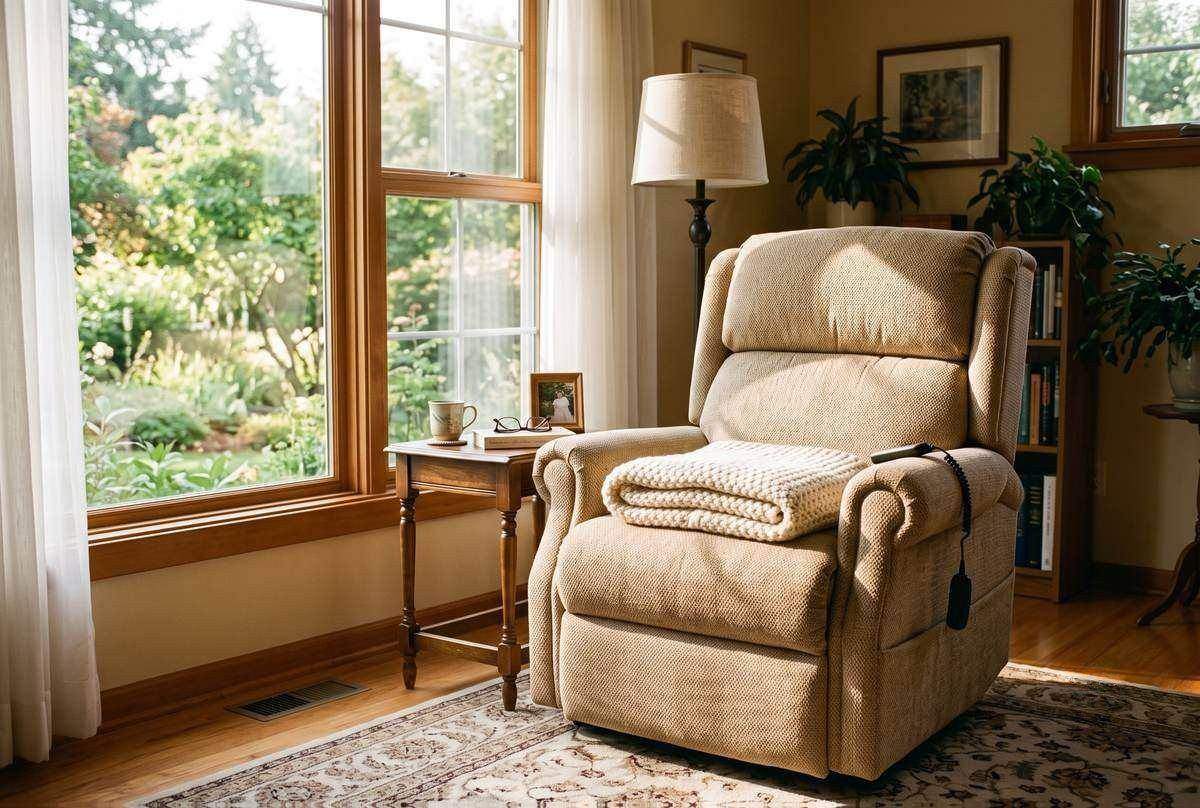
In the chair section near the windows was a woman named Val who had to be 80. Val did the entire class in her chair and got more out of it than I did, because Val could actually breathe through her poses while I was negotiating with my left hip. The chair people are not the JV team. The chair is a tool. If standing balance is shaky, or knees object to kneeling, the chair is the right answer, full stop. A yoga pose done correctly in a chair is worth more than the same pose done wrong on a mat.
My honest take, after that class and two more like it: most people over 65 should start in a chair for at least the first month, even if they think they don't need to. You learn the shape of the pose without the panic of balance. Then you graduate to the floor, or you stay in the chair forever, and either is fine. Renee told me on the way out that she's had students in their seventies who never left the chair and got perfectly strong and flexible anyway. Her exact words: "The chair is not a downgrade. It is a different door into the same room."
The five poses I actually do
These are not glamorous. None of them will end up on the cover of Yoga Journal. They are the five I do most mornings in my office before Frank wakes up, on a mat I bought at Target for $22. I picked them because they address what actually goes wrong in a 70-year-old body: stiff spine, weak balance muscles, tight hamstrings, hip mobility that disappeared sometime around 2017, and circulation in the legs that takes its sweet time.
1. Cat-Cow, seated or on hands and knees. This is the single most useful movement I've added to my day. You either sit in a chair with your hands on your knees, or you kneel in a tabletop position if your wrists and knees allow. Inhale and arch the spine, lifting the chest and tailbone (that's cow). Exhale and round the spine, dropping the head (that's cat). Eight to ten rounds. The first time I did it I heard my own back say, audibly, oh. The reason I do this every morning now is because I no longer feel like a hinge that needs oil when I get out of the car at the Safeway. If you do nothing else on this list, do this one. (And yes, ask me how I know it helps after a long flight.)
2. Mountain pose with weight shifts. Stand with feet hip-width apart, near a wall or a sturdy chair you can touch with one hand. Shift your weight slowly to the right foot. Hold for a slow breath. Shift to the left. Hold. Do this for two minutes. That is the entire pose. It looks like nothing, I know, and the woman next to me in class clearly thought we were being patronized. But this is the boring exercise that retrains the small ankle and hip stabilizers that prevent falls, which is the single most important thing in this article. A 2019 systematic review of yoga for older adults found modest balance and flexibility benefits, not magic, with the strongest effect coming from poses exactly like this one. (Tai chi, for what it's worth, has stronger falls-prevention evidence than yoga. I've put it on my list.) For the broader picture, see our piece on falls prevention exercises for seniors.
3. Forward fold, standing with bent knees, or seated. Stand with feet hip-width apart, bend your knees more than you think you should, and slowly fold forward, letting your arms hang. Keep the knees bent. Do not chase your toes. Your toes will still be there when you finish. If standing forward fold feels unsafe, and for some people it does, sit on the front edge of a chair and fold over your thighs, arms relaxed. Hold for five slow breaths. This is the one that opens up the back of the legs and the low back at the same time, and after a week of doing it daily, the laundry basket got measurably lighter to lift off the floor. Renee told me never to lock the knees in this pose. I have not locked them since.
4. Warrior II, shorter stance than the magazines show you. This is the one that made me feel briefly like I was 50 again, which is reason enough to include it. Stand with feet about three to three and a half feet apart, not the four-plus the YouTube instructors demonstrate, front foot pointing forward, back foot turned out about 75 degrees. Bend the front knee toward 90 degrees but no further than your ankle. Arms out to the sides at shoulder height. Hold for five breaths. Switch sides. The shorter stance protects the back knee and hip; the wider one looks impressive on Instagram and wrecks people over 65. This pose builds leg strength in a way no machine in a gym does, and pairs beautifully with whatever strength training routine you already have going.
5. Legs up the wall (Viparita Karani). This is my favorite pose in the world. You lie on your back, scoot your hips toward a wall, and put your legs straight up against it. That's the whole thing. Stay there five to ten minutes. The first time I did this, I almost fell asleep, which is apparently the correct response. It improves circulation in the legs, which after a long day in the desert heat is something I notice the way other people notice a paycheck. The only catch: you have to be able to get down to the floor and up again. If that's a hard no, lie on the bed with your legs against the headboard. The benefit is similar. I will go to my grave defending this pose. Frank has tried it exactly once, stayed fourteen minutes, got up and said, "Hm." That is Frank for life-changing. I am still working on him.
The poses to skip, even when somebody tells you they're "modified"
A handful of poses get sold as senior-friendly that simply are not, and a modified version does not fix the underlying problem. I am not the boss of your body. But.
- Headstand and shoulderstand. Period. Not even modified. The cervical spine takes load it was not designed to take, and over 60, the consequences of a wrong move there are not worth any benefit you could name.
- Full downward dog. It looks like a stretch and it's really an inverted plank that asks the wrists, shoulders, and cardiovascular system to do a lot at once. If your blood pressure is unmanaged or your wrists complain, skip it. The wall version (hands on the wall at hip height, walking the feet back) gets you 80% of the benefit and zero of the risk.
- Lotus and half-lotus. Knees and hips after 65 mostly do not want to do this, and will tell you about it for three days. Sit cross-legged on a folded blanket and call it good.
- Pigeon pose. Sold as a hip opener. Often just an injury waiting to introduce itself. There are safer hip openers (figure-four stretch on the back, for one), and any decent teacher will offer them.
- Sudden floor-to-stand transitions in a flowing class. If you are at any fall risk, a vinyasa class moving fast between standing and floor poses is not the class for you yet. Find a gentle or restorative class. There is no shame here. Renee's one rule for new students over 70 is that no transition should ever surprise the body. Write that one down.
Real teachers and the YouTube question
Here's the thing about learning yoga from a screen: it is fine, eventually, but not at first. Yoga injuries are not theoretical. I have a friend named Kitty (she's 68, she was in my book club back in Wilmette, she lives in Phoenix now) who tore her rotator cuff doing chaturanga from a YouTube video in her living room with no one to correct her form. She did not return to yoga for two years. She came back, and she's fine now, but she said something I think about: "I learned what good form felt like from a person in the room. Then YouTube was useful. Not before."
My honest recommendation, if you are new to this after 65: take six to eight in-person classes at a community center, senior center, or local studio that offers "gentle" or "chair" yoga. The drop-in rate at most rec centers is $4 to $12. The instructor will correct your form and tell you which poses are not for you. After that, YouTube is your friend. Yoga with Adriene has a free senior series. DDP Yoga has surprisingly good modifications. The books I keep coming back to are Suza Francina's The New Yoga for People Over 50 and Rachel Krentzman's work on yoga therapy.
And the magazine claim, that yoga will change your life? The honest answer is that it improves flexibility, hip mobility, sleep, and mood, and that is a lot for one practice to do. It is not magic. It will not make you 35 again. It will, after about a month of regular practice, make you the version of 72 who can put on her own socks without sitting down, which is a small kingdom worth defending.
The woman who napped through final relaxation
At the end of every yoga class is something called Savasana, when you lie on your back for five to ten minutes while the teacher says calming things and you are supposed to be "present." In my first class, in the row in front of me, was a woman in her mid-eighties who fell asleep in Savasana and snored. Loudly. Not a delicate snore. A full freight-train snore that built and built and finally produced a small sound from the woman next to her that I think was a stifled laugh.
Renee did not wake her. Renee finished the class, dimmed the lights further, and quietly told the rest of us we were free to go. The woman slept on. I tiptoed past her on the way out.
In the parking lot, I thought: she has it figured out. The whole point of all of this is to give an aging body permission to rest. Permission to take up space on the floor. Permission to fall asleep mid-relaxation in the presence of strangers who will not laugh at you, because by 72, everyone in the room knows the body needs what the body needs.
My hips were quieter than they had been in a week. I drove home, made tea, and told Frank I was going back next Tuesday. He said, "Hm." Which, as established, is Frank for good.
I'll see you on the mat. Or in a chair. Either way works.