I was in the produce aisle of a Scottsdale Safeway, in March, holding a clamshell of grocery-store tomatoes that had clearly been picked while they were still arguing about it, when the smell of one of them — not the fruit, the stem, the green snap of vine where someone had broken it off — put me, without permission, in a backyard in Georgia in 1960.
I'm 72. The grandmother who taught me what a tomato vine smells like in heat has been gone for forty-some years. The distance from her dirt to mine is two thousand miles and four decades, and yet there I was in fluorescent lighting, holding a plastic box, suddenly seven years old in a cotton dress with my hair in two braids.
I bought the tomatoes. I cried a little in the car. I didn't mention it to Frank, because some arrivals are private. You hold them up to the light by yourself before you decide who else gets to see them.
This essay is what I held up to the light.
Who She Was
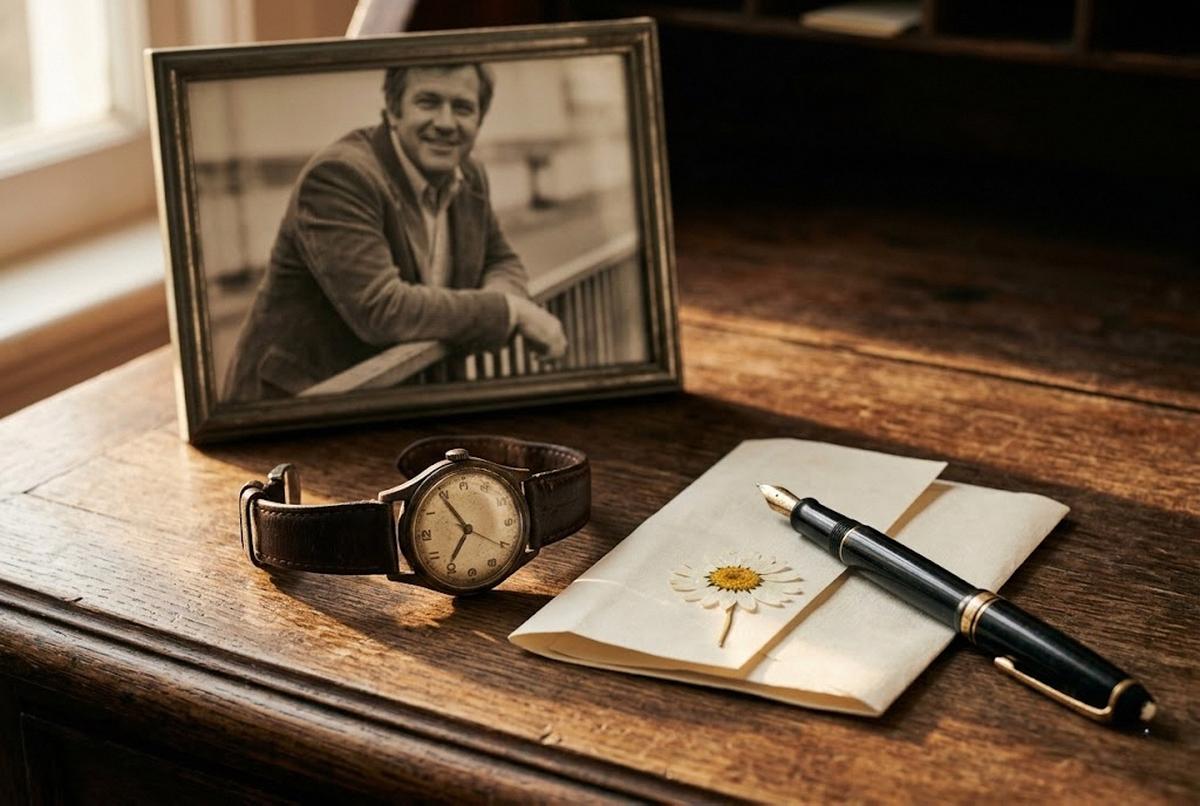
She was small. That's the first thing — small in the way that women born around 1898 were small. Maybe five-foot-one. Hands that looked like they belonged to a woman six inches taller, that had done every kind of work hands can do, without comment. Knuckles that knew weather before the weather knew itself. A wedding ring she had not removed since 1919, set so deep into the finger that when she died they had to cut it off, and my mother kept the cut ring in a velvet box until 2012, when I inherited both the box and the obligation to know what to do with it.
She lived outside a town in middle Georgia that I will not name, because the town is not the point and the woman is. Pine country. Red dirt. The kind of summer that makes asphalt soft by ten in the morning and the porch swing creak in a way you remember in your sleep forty years later. A husband who had been a railroad mechanic and had died of something nobody quite explained to me as a child. A son who became my father's neighbor and a daughter who became my mother. A garden plot the size of a postage stamp that fed her household and several others. A habit of saying exactly what she meant, in a low voice, with her chin tilted just slightly down so you understood she was not asking your opinion.
She was, as a woman who once wrote me a letter about her after the funeral put it, armored in humor, soft underneath, gone too soon. I have carried that sentence in my pocket for years. It is the only obituary she ever got that I felt was accurate.
The stubbornness is the thing my mother said I inherited. I take the compliment, although my mother did not always intend it as one. My grandmother once stood in her own front yard in a thunderstorm because a man from the county had told her to move her mailbox three feet to the left. She did not move it. The man came back. She did not move it. The mailbox is, presumably, still there, although the woman who refused to move it is not. I think of her sometimes when a homeowners' association in the Sonoran desert tells me my plastic tumbler of rosé constitutes a perception issue. The line of descent is clear.
The God She Kept Her Own Counsel About
She did not go to church. Not as a statement. As a matter of preference. The church she did not go to was a white frame building a mile down the road, and she had, as everyone in the family learned to repeat, very firm opinions about pew-sitting.
The opinions were not, as far as I could tell, theological. She believed in God in some private, ground-level way she never explained. What she did not believe in was the business of sitting in a varnished bench for an hour and twenty minutes while a man in a tie told her things about her own soul he could not possibly have known. She put it more bluntly than that, but the gist held. She suspected that anyone who needed a man in a tie to tell him what his soul was doing on a Wednesday was not paying close enough attention the rest of the week.
She paid attention the rest of the week.
I taught high school English for thirty-four years — which is to say, literature — which means I spent thirty-four years noticing how the South argues with itself about faith — the O'Connor argument, where grace shows up uninvited and rearranges the furniture; the Berry argument, where the farm is the sanctuary and the work is the liturgy. My grandmother had never read any of them. She did not need to. She had landed, on her own, with a third-grade education and a Methodist mother she had outlasted by half a century, in a theology that was indistinguishable from her gardening. She believed in attention. She believed in showing up. She believed in keeping your word to a tomato plant.
She also believed, fiercely, in not being told. She was suspicious of people who needed institutions to feel their feelings for them. She was suspicious of bumper stickers, decades before bumper stickers existed in their current form. If you wanted to know what she believed, you watched what she did. If you wanted her to tell you what she believed, you would die waiting.
My mother, who tried for years to get her to come to church on Easter, finally gave up around 1965. My grandmother told her, on the porch, in a voice my mother repeated word for word for the next forty-seven years: "Dorothy, I have made my peace with the Lord on a riding lawn mower. He knows where to find me." My mother was still laughing about it the year she died.
The Tomato Vine
The scene the Safeway sent me back to is short. I have written about it once before, in a piece about gardening with arthritis, but only as a passing summary — the way you mention a doorway you walked through without describing the room. This is the room.
I was seven. The summer was 1960, and the heat in Georgia in July arrived like a personality — it walked into the room and you adjusted around it. I was wearing a blue cotton dress my mother had ironed against my objections. My hair was in two braids my grandmother had redone that morning because she found my mother's work, and I quote, "insufficiently committed." I had been sent out to keep her company while she did whatever it was she did to the tomatoes every afternoon. It is possible she did not need company. She wanted it anyway.
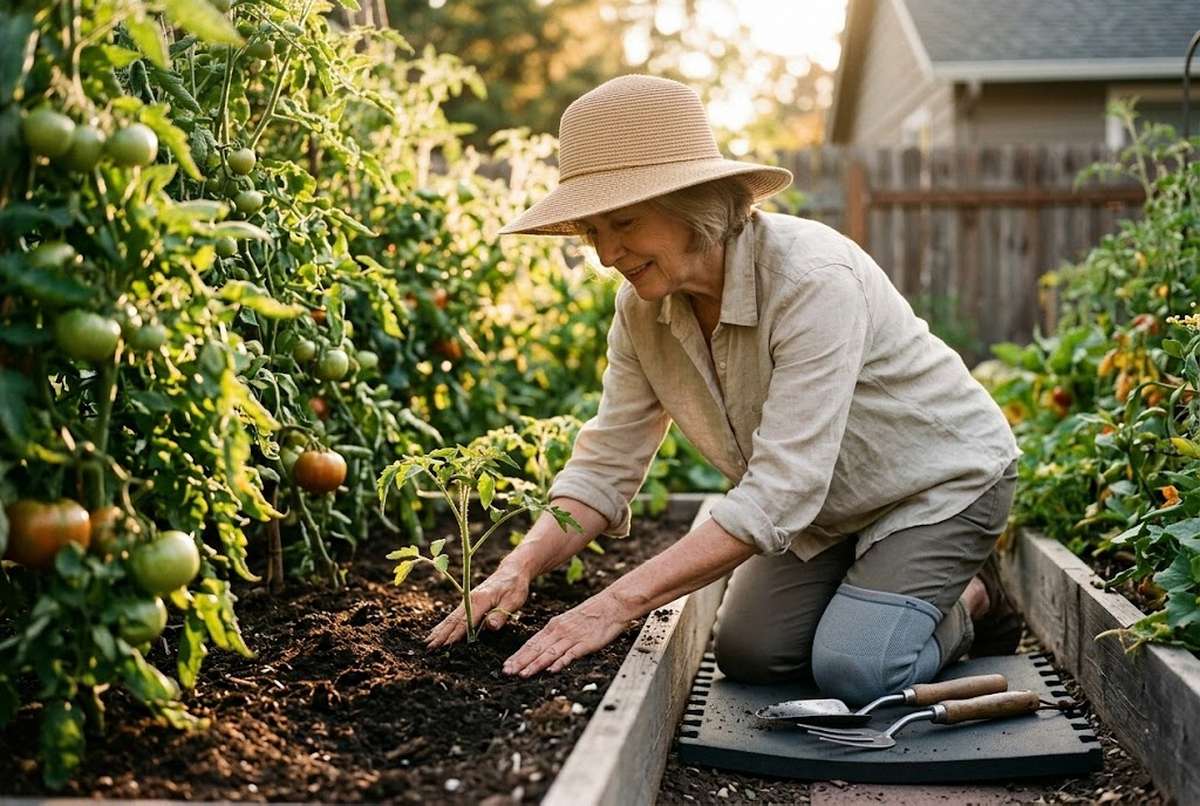
The plot was small. Maybe twelve feet by twenty. The tomatoes were on the south side, staked with whatever lumber she had been able to argue out of her brother-in-law that spring. She knelt — and she was sixty-two, which seemed ancient to me then and seems suddenly young to me now — and she pinched a leaf between her thumb and forefinger, and she held it up under my nose without speaking. The smell. I do not know how to describe the smell of a tomato vine on a hot Georgia afternoon to anyone who has not smelled one, except to say it is green and sharp and slightly bitter and entirely alive, and it is the smell a plant makes when it is not asking your permission to be there.
She said, "That's the closest thing to a prayer I know, Victoria."
I did not understand her. I knew prayer was something you did with your eyes closed and your hands together, which was nothing like the leaf and her thumb. I nodded, because I was seven, and seven nods.
We stood up. She brushed off her knees. She handed me a green tomato off the vine — the one she would have left for the weekend, the one she sacrificed to a child's afternoon. We went inside. She fried it in cornmeal and bacon grease, the way her own mother had taught her, and I ate it standing at the counter, and the bottom of the dress my mother had ironed got a grease stain on it that did not come out, and I was not punished, because my grandmother was there, and my grandmother said nothing about it, which was its own kind of permission slip.
I was sixty-three years old before I understood what she had told me at the vine. By then she had been dead for a long time, and I was kneeling in my own dirt in Scottsdale in front of a tomato my husband had teased me into planting, and I pinched a leaf, and the smell did the work without my asking it to. She was right. I do not have a better word for it either.
What She Lived Through
She was born around 1898 — the math is approximate, because the records of a rural Georgia county at the turn of the century are partial. She lived to 1981. Eighty-three years. The list of what eighty-three years from 1898 to 1981 contained, when you stop to write it down, is staggering.
The 1918 flu, which took a brother I never met. The Depression, which she did not call the Depression — she called it the years we ate a lot of beans, in a tone that suggested she had not forgiven the beans. Two world wars. The civil rights movement, which she lived through in the South and which she did not, in my hearing, discuss; Everything I ever understood about her on that subject came from the specific quiet she kept when certain neighbors came up. I will not claim a moral position for her she did not claim for herself. I will say she was watchful. She had eyes. She was raised by a Methodist mother in 1905 and lived to see her granddaughter graduate from college in 1975, and the distance between those two facts is the size of a planet.
She also lived through, more privately, the deaths of two children before me — an uncle who died at eleven of what they called scarlet fever, and an aunt lost at three weeks. She did not speak about them. I learned about them from my mother in passing, the way I learned about most things that mattered. There is a kind of grit that is not optional, that history hands you because it is in the room anyway, and you can either fold yourself around it or be folded. She folded around it. She made tomatoes.
Turns out, when I was a child, I thought she was hard. I mean that as a child notices hardness — she did not coo, she did not gush, her affection arrived through groceries and re-plaited hair and the green tomato off the vine. I did not understand that hardness was the shape softness takes when the world has been rough on it for a long time. I figured that out around forty, the way most things get figured out around forty, by reading a writer who had figured it out at twenty-five and then having to live a few years to know what she meant.
My grandmother was not hard. She was efficient with her tenderness. There is a difference. I have come to think it might be the most Southern thing about her, although I have also come to think Southern is doing too much work in that sentence and I will let it stand anyway.
Here's the Thing
Here's the thing I did not understand for sixty years and understand now.
She did not teach me lessons. Lessons are what teachers do, and I would know — I gave them for thirty-four years, and I have a regional plaque in my bathroom to prove it. What she did was different. She let me stand next to her while she did the things she did, and she occasionally said something brief, and the saying was almost beside the point. The point was the standing next to.
I catch myself, at 72, doing things in her shape. I keep my chin slightly down when I disagree with someone and want them to know it without my having to spend words. I have been known to refuse to move a perfectly good piece of patio furniture because a Scottsdale HOA woman named Gayle told me to. I make a single batch of fried green tomatoes every August on a Saturday morning when Frank is at the course, and I eat them standing at the counter, and I have not told anyone in the family that I do this, and so I am telling you. I have, on more than one occasion, said something in my own kitchen out loud that I recognized halfway through the sentence as a thing she would have said, and I had to sit down for a minute, because my voice had moved without my permission.
My granddaughter Lily is eight. She is the spitting image of me at her age — which means she is also the spitting image of a woman she did not meet and will not meet, who died fourteen years before her mother was born. Lily came to Scottsdale at Easter and helped me plant the patio tomatoes. She knelt on a foam pad. She wore a sundress. The braids were her idea. I had not suggested them.
She pinched a leaf. She did not know why she was pinching the leaf. She held it up and said, "It smells weird, Grandma."
I said, "Yes, baby. That's the one."
She will not remember that sentence. But I will, and the smell will be there for her later, somewhere in a grocery store in a city I cannot picture, when she is in her own forties and the past will arrive and ambush her at a misting nozzle, and she will not know why, and that will be the inheritance, and the inheritance will be enough.
Gone Too Soon
She died in March 1981. I was 27.
I got the call in my classroom at Evanston Township, between fourth and fifth period, on a Tuesday. I taught fifth period anyway. I do not remember the lesson. I remember the drive to my parents' house afterward, and the way my mother — Dorothy, sharp Dorothy, who would not live to fifty without breaking — opened the door and did not say anything, just nodded, the same chin-tilt her own mother used, the line of women going back through the door.
I cleared the small house in Georgia three weeks later, with my mother, in a heat already mounting in April toward what April mounts toward in middle Georgia. We found the cut wedding ring. We found the recipe card for fried green tomatoes, in a script that looked like a railroad timetable. We found a tin of buttons saved across sixty years, because she would not have thrown a button away if you had paid her. (I have written elsewhere about clearing a parent's home, and about the part nobody warns you about retirement, which is that the people you loved keep dying for the rest of your life, and you keep cleaning out their houses, and the houses get smaller and the silences get larger.)
She was eighty-three. By any reasonable standard, not gone too soon. By the standard of the granddaughter who wanted one more summer in the garden, who wanted her at the wedding I had not yet had and at the births I had not yet had and at the kitchen table for the next forty years' worth of arguments — gone too soon. I do not think either standard is wrong. I think they live in the same chest at the same time, and you make room for both, and you go on.
There is a shape in the air where she used to stand. I am 72, and I am still walking around it, and on certain Saturdays in August, with the patio door open and the cicadas going, I can hear her not saying anything, which was always the way she meant the most.
The tomatoes don't care either way. She would have laughed at that.