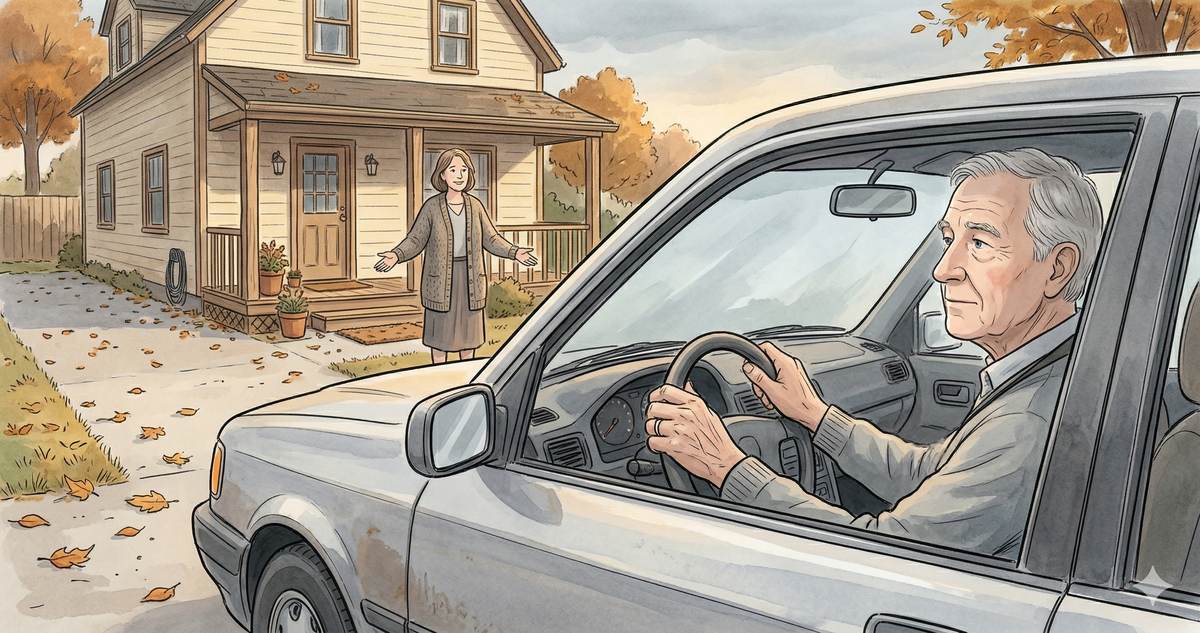
My friend Lynne handed her father's car keys to her brother in a Denny's parking lot on a Tuesday in October, and she cried harder than she did at her own divorce.
Lynne is 70. Her father, Arnie, was 93. He'd been driving his 2003 Mercury Grand Marquis, burgundy, with a dent in the rear quarter panel he couldn't explain and a scratch along the passenger side he blamed on "the parking lot at Walgreens." Twenty-one years behind the wheel of the same car. The dent was new.
I wasn't there. Lynne told me about it three weeks later at Desert Glow Salon, both of us in foils, Maria working her magic while Lynne stared at the ceiling and said, "I feel like I took his legs."
Frank still drives. He's 74, sharp, golfs three times a week, handles his Buick Enclave competently and calmly with both hands on the wheel. No concerns. Not yet. But I watched Lynne's face in the salon chair and I thought, someday this will be us. One of us will have to say something to the other, or one of our kids will have to say it to us.
So I've been thinking about how to do this right. Before we need to.
The Warning Signs Nobody Wants to See
Arnie's family didn't miss the signs. They saw them. They just didn't want to believe what they were seeing, which is a completely different problem and a much harder one to fix.
The National Highway Traffic Safety Administration lists the signs plainly: drifting between lanes. Running stop signs or red lights. Confusion at intersections. Driving well below the speed limit. New dents with no explanation. Getting lost on familiar routes. Other drivers honking constantly.
Lynne told me Arnie ran a solid red light on McDowell Road in Mesa last September. The car behind him honked. Arnie said the sun was in his eyes. Two weeks later, his neighbor Glen found Arnie sitting in the Grand Marquis in the Safeway parking lot, engine running, unable to remember why he'd driven there.
One incident is a bad day. Two is a pattern.
According to the Insurance Institute for Highway Safety, 5,679 people 70 and older died in motor vehicle crashes in 2024, and per mile traveled, fatal crash rates rise noticeably starting at ages 70 to 74 and are highest among drivers 85 and older. Plenty of 80-year-olds drive better than my son Tom in a parking garage. But the risk curve is real, and loving someone doesn't bend it.
Check the car. Walk around it. New damage you haven't heard about is the clearest signal.
Why This Conversation Feels Like a Funeral
I taught high school English for 34 years. I've had approximately 600 difficult conversations with parents who didn't want to hear what I was saying about their child. None come close to this one.
Because driving equals identity. The car isn't transportation. The car is "I can go where I want, when I want, without asking anyone's permission." The car is Tuesday mornings at the coffee shop with Dale. The car is the pharmacy and the doctor and the friend whose house is eleven miles away with no bus route.
Take the keys and you're not removing a privilege. You're removing a self.
My mother, Dorothy, stopped driving at 78. Not because anyone made her. She scraped the garage door frame for the third time, looked at it, and said, "Well, I suppose that's so." Said it the way you'd announce a weather change. But I remember the months afterward. She asked me for rides in a voice she'd never used before. Smaller. Not angry. Just... reduced.
Dorothy, who once told a bank manager his tie was "an act of aggression against the eyes." Asking me in a quiet voice if I could take her to the Jewel-Osco on Thursday. If you've ever tried telling your adult kids you're fine when they won't stop worrying, imagine how much harder it is when you're the one who isn't fine anymore.
No wonder Lynne cried in the parking lot. You're not taking keys. You're watching someone become a passenger in their own life.
How to Have the Conversation Without Starting a War
Lynne did it wrong, and she knows it. She got frustrated, said "Dad, you can't drive anymore," in the Denny's, and Arnie didn't speak to her for nine days.
Nine days!
So how do you do it right?
The Hartford Center for Mature Market Excellence and MIT AgeLab developed a free guide called "We Need to Talk," available at thehartford.com. Best resource I've found. No magic words, but a framework giving you a chance of being heard instead of shut out.
First, don't ambush. Not in public, not at a holiday dinner, not with the whole family assembled like an intervention. "We've all been talking" is the phrase that makes every parent on earth feel ganged up on.
Pick one person. The one the parent trusts most — which might be the youngest or the daughter-in-law or the golfing buddy. Sometimes the right messenger isn't family at all.
Start with concern, not conclusions. "I've noticed a few things and I'm worried" lands differently than "You need to stop driving." One opens a door. The other slams it.
Ask questions. "How do you feel about driving lately?" You might be surprised. Some older adults are already scared behind the wheel and relieved someone finally asked. The Hartford guide found many seniors had already limited their own driving before anyone said a word. No highways, no night driving, no rain. They'd noticed. They just hadn't said it out loud because saying it makes it real.
Don't make it all-or-nothing. "Maybe we start with no night driving" is easier to accept than "hand over the keys forever." Multiple small talks over months work better than one confrontation.
And have a plan for what comes next. If you say "stop driving" with no answer for "then how do I get to the pharmacy," you've told someone they're trapped.
The Alternatives That Actually Work
Most articles skip this part, and it makes me furious. You can't tell someone to stop driving and then shrug about what replaces it.
Ride services: GoGoGrandparent lets seniors book rides by calling 1-855-464-6872, pressing 1, and a car shows up — no app, no smartphone. You pay the Uber or Lyft fare, a $0.27-a-minute concierge fee, and a monthly or yearly GoGo membership. Not cheap. Actually, wait — it's far less than the $12,863 a year AAA estimates it cost in 2026 to own and run a new car. SilverRide, which says it operates in more than 35 metro areas, offers assisted rides in which drivers can help riders between the door and the vehicle. If you're comparing the real costs of aging at home, transportation is the line item people forget.
Community transit: Most cities operate paratransit for seniors. In the Phoenix metro, Valley Metro and its member cities run Dial-a-Ride services; who qualifies, what a trip costs and how far ahead you must book vary by city, so call before you count on it. Call the Eldercare Locator at 1-800-677-1116 to find what exists where you live.
Family schedules: Lynne and her brother set up a shared Google Calendar. Each sibling claimed two days a week. Arnie's granddaughter Megan, who works from home, took Thursday afternoons. It lasted three months before the schedule slipped, because real life doesn't pause for logistics. Lynne hired a part-time aide for the gaps — $18 an hour, three afternoons a week.
Volunteer programs: The ITN (Independent Transportation Network) provides rides on a membership basis. ITNAmerica also runs Rides in Sight, a searchable national database of ride programs you can filter by ZIP code, cost, and wheelchair access, at ridesinsight.org or 855-607-4337.
The alternative doesn't have to be one thing. It's a patchwork. Uber on Monday. Granddaughter on Thursday. Paratransit to the doctor. No single solution replaces a car in the driveway. Four or five together can come close.
When the Doctor Needs to Be the Bad Guy
Sometimes you've had the conversation and your parent said no. Or said yes and kept driving anyway. Or said, "My driving is fine," in the tone meaning the discussion is over.
Bring in the doctor.
I don't say this lightly. But here's the thing: doctors can order driving assessments, and in a handful of states they're required to report patients who may be unsafe behind the wheel.
California and Pennsylvania are among the states that require it. In others, Arizona included, a doctor may report but doesn't have to. California's rule covers disorders marked by lapses of consciousness, which by law include Alzheimer's disease and related disorders severe enough to impair driving; Pennsylvania's covers a defined list of conditions. For what your own state demands at license renewal, the Insurance Institute for Highway Safety keeps a state-by-state table at iihs.org/research-areas/older-drivers/license-renewal-laws-table.
Occupational therapists specializing in driver rehabilitation can administer a Clinical Driving Assessment that evaluates reaction time, vision, cognition, and actual behind-the-wheel performance. Prices vary, so ask what it costs and whether insurance covers any of it before you book. If the assessment says someone isn't safe, the family didn't take the keys. The data did.
Arnie's doctor, Dr. Vasquez, made the difference. She told Arnie she wanted him to take a driving assessment, framed it as something she asks all her patients over 90. Arnie agreed because it wasn't his daughter calling him incapable. It was his doctor suggesting a test. Men of Arnie's generation respond to professionals in a way they will never respond to their children. (I taught their children. Trust me on this!)
He scored poorly on vision and reaction time. The assessor recommended he stop driving. Arnie accepted it from a stranger with a clipboard in a way he never would have accepted from Lynne in a Denny's.
State License Renewal: What the DMV Requires After 65
Every state handles this differently, and most people have no idea what their state requires.
Illinois, where I spent most of my life, used to require a road test at every renewal from age 75. Since July 1, 2026, the road test applies at 87 and older, though drivers 79 and older must still renew in person. Arizona, where I live now, requires a vision test at renewal, and after age 60 a license runs five years at a time. Five years is a long time at 80. That gap bothers me.
Rules vary widely. Illinois now requires a road test at 87 and older. Iowa requires in-person renewal with a vision check from age 70 and shortens licenses to two years at 78. Maine shortens licenses to four years at 65. New Hampshire has no age-based renewal rules at all.
An 85-year-old in Florida can renew online every other time without leaving the couch, as long as a doctor or eye doctor sends in a passing vision test. No road test. No driving evaluation of any kind.
The DMV is not your safety net.
In most states, any concerned person can submit a Request for Reexamination to the DMV. The DMV contacts the driver, schedules a test. Not perfect, but it puts the evaluation in neutral hands. Don't count on staying anonymous, though. Confidentiality rules vary by state. If that matters to you — and inside a family it usually does — ask before you file.
What I Haven't Said to Frank
We were driving home from dinner last Saturday. Frank behind the wheel, me in the passenger seat, audiobook paused because I had something to say.
The conversation didn't happen. I looked at him driving, checking mirrors, smooth lane changes on Shea Boulevard, stopping fully at the yellow. He's fine. Genuinely fine.
But I called Tom on Sunday. Not because anything was wrong. Just to say, "When the time comes, for either of us, I want us to already have a plan."
Tom, being Tom, said, "I've already drafted a spreadsheet."
Of course he has.
Carrie called twenty minutes later because Tom texted the sibling group chat. "Mom, is Dad okay?" I said, "Your father is fine. I'm planning ahead because I'm not going to wait until someone has to cry in a parking lot."
Then she said, "What about you?"
Good question. I'm 72. I parallel parked outside a restaurant in Old Town Scottsdale last week without thinking about it, and the space was tight enough that even a cohousing design committee would have needed three meetings to approve the maneuver. But I won't always be fine. Neither will Frank. The hardest part of this whole conversation is admitting the person who needs to hear it might eventually be you.
Frank came into the kitchen while I was finishing this piece. Read over my shoulder for a minute, standing there with his coffee like an editor who charges nothing and says very little.
"Good article," he said.
Then, after a pause: "When it's me, don't take me to Denny's."
Forty-seven years, and the man can still make me laugh when I'm trying not to cry. That's a kind of grace you don't find in any driving manual. Told him we'd go somewhere with better coffee. He said fair enough. Then he went back to his golf magazine, and I sat there grateful for a man who can talk about the hard thing and then let it be.
Call your siblings. Make the plan. Don't wait for the dent you can't explain.