A woman at my Westport Senior Center workshop last October raised her hand and asked a question the room wasn't ready for. She was 73, a retired dental hygienist from Fairfield, and she'd been paying $387 a month for a single cancer medication through her Part D plan. After deductibles, coinsurance, and the old coverage gap, her annual drug bill topped $6,200. She looked at the whiteboard where I'd written the number $2,100 and said, "Benjamin, are you telling me that's all I'll pay now?"
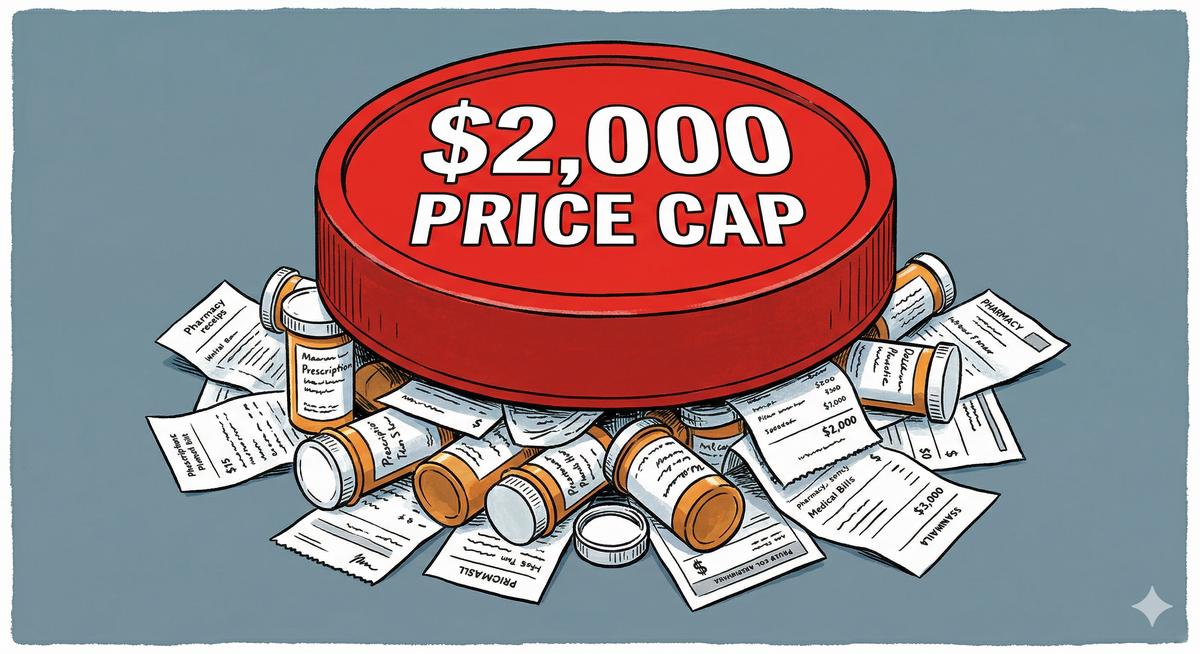
Yes. Starting January 1, 2025, Medicare Part D caps your total out-of-pocket prescription drug spending for the year — and for 2026 that cap is $2,100. Not per drug. Not per quarter. Per year. Once you hit $2,100, you pay nothing for covered prescriptions for the rest of the calendar year. Zero. And a companion option that launched in 2025, the Medicare Prescription Payment Plan, lets you spread that $2,100 across monthly installments with no interest and no fees.
I've been a financial planner for 35 years. I've watched Medicare evolve, stumble, contradict itself, and occasionally get something unambiguously right. The $2,100 cap is one of those rare moments. But the mechanics matter, and most of what I've seen published about this provision skips the details determining how much you actually save.
So here's what I'd tell you if you were sitting in the second row at my workshop, pen in hand.
How the $2,100 Cap Actually Works
Before 2025, Medicare Part D had no annual out-of-pocket maximum. None. You paid your deductible ($590 in 2025, $615 in 2026), then copays or coinsurance through the initial coverage phase, then you entered the infamous "donut hole" where costs spiked, and then you reached catastrophic coverage where you still owed 5% of drug costs indefinitely. Five percent sounds small until your oncologist prescribes a biologic running $14,000 a month. Five percent of $14,000 is $700. Every month. No ceiling.
The Inflation Reduction Act killed that structure.
The new Part D structure works like this. You pay your plan's deductible (most plans set it at or below the $615 maximum for 2026). You pay copays or coinsurance on covered drugs. Every dollar you spend out of pocket counts toward the $2,100 cap. The moment your cumulative out-of-pocket spending hits $2,100 in a calendar year, your plan covers 100% of remaining drug costs through December 31. The counter resets January 1.
What counts toward the $2,100: your deductible payments, copayments, coinsurance, and amounts you pay during any coverage gap. What doesn't count: your monthly Part D premium, costs for drugs not on your plan's formulary, and any payments made by programs like Extra Help.
One thing I want to be direct about: this cap does not reduce the price of your medications. It limits what comes out of your pocket. Your plan still pays the pharmacy. The drug still costs what it costs. But you, personally, are done at $2,100. The difference between "cheaper drugs" and "capped exposure" matters for understanding your monthly bills.
The Medicare Prescription Payment Plan: Spreading the Cost
Twenty-one hundred dollars on January 3rd hurts differently than $175 a month.
The Medicare Prescription Payment Plan, which launched January 1, 2025, lets you spread your out-of-pocket Part D costs into predictable monthly payments. No interest. No fees. No credit check. You're not borrowing money. You're rearranging the timing of payments you already owe.
You opt in through your Part D plan, standalone or Medicare Advantage. Once enrolled, your plan estimates your total out-of-pocket drug costs for the year based on your current prescriptions and divides them into roughly equal monthly installments.
Say your plan projects $1,800 in total out-of-pocket costs for the year. Instead of paying $615 for your deductible in January and then varying copays each month, you'd pay approximately $150 per month, January through December. If actual costs run higher or lower, the monthly amount adjusts. You never pay more than $2,100 total.
You can opt in at any point during the year. If you enroll in March, your remaining projected costs get divided across March through December. CMS requires plans to notify enrollees about this option, but I've found the notices arrive buried on page 14 of a 30-page document. Call the number on your Part D card and ask directly.
One catch worth knowing. If you switch Part D plans mid-year, your payment plan doesn't transfer. You'd re-enroll with the new plan and recalculate.
Who Saves the Most — And How Much
The $2,100 cap helps everyone on Part D. But it doesn't help everyone equally.
The biggest beneficiaries were spending well above $2,100 annually before the cap existed. Specialty medications. Cancer drugs, biologics for rheumatoid arthritis, immunosuppressants after organ transplants, high-cost diabetes medications.
I ran numbers for a few scenarios based on 2026 pricing.
Scenario 1: Virgil, 69, retired machinist from Bridgeport. Takes Entresto for heart failure ($295/month negotiated price) and Jardiance for Type 2 diabetes ($197/month). Under his 2024 Part D plan, Virgil paid $4,400 out of pocket annually between deductibles, coinsurance, and the old coverage gap. Under 2026 rules, his maximum is $2,100. Annual savings: $2,300. Roughly the cost of a year of home modifications his wife has been asking about.
Scenario 2: Beatrice, 74, retired school librarian from New Haven. Takes Enbrel for rheumatoid arthritis. Enbrel's negotiated price dropped to $2,355 per month, but even at the reduced price, one month of coinsurance would have pushed her past the old catastrophic threshold. Before the cap, her annual out-of-pocket was approximately $8,100. Now? $2,100. She saves about $6,000 a year! She cried in my office when I showed her the math. Actually cried. I handed her the box of tissues Maggie keeps on my credenza and let her sit with it.
Scenario 3: Leonard, 77, former Sikorsky engineer from Stratford. Takes a generic statin ($12/month copay), a generic blood pressure medication ($8/month), and a generic proton pump inhibitor ($10/month). Annual out-of-pocket before the cap: about $950. After the cap: $950. The cap doesn't change anything for Leonard because he was already under $2,100. He's the person the cap wasn't designed for, and fine by me. Not every provision needs to help everyone equally to be good policy.
The pattern is clear. If your annual drug costs were below $2,100, you won't notice the cap. If they were between $2,100 and $5,000, you save hundreds to a few thousand. If they were above $5,000, especially on specialty drugs, the savings are life-changing. A KFF analysis estimated that about 1.5 million Part D enrollees without low-income subsidies spent $2,000 or more out of pocket on drugs in 2021, the most recent year of claims data it analyzed. Every one of them would benefit from a cap like today's.
And here's the part even I didn't expect. I was reviewing my own Part D costs in December, running the numbers the way Maggie once told me to: "Like I'm a client, not your wife." (She said it about our retirement plan, but the principle holds.) My out-of-pocket drug costs are modest. Generic cholesterol medication, generic blood pressure pill. I'm a Leonard, not a Beatrice. But Maggie takes a brand-name thyroid medication running $89 a month after her plan's coinsurance. Between the two of us, the cap creates a small cushion we didn't have before. Not dramatic. But real.
How the Cap Works with Extra Help and LIS
If your parent receives Extra Help (the Low-Income Subsidy, or LIS), the $2,100 cap interacts differently than you'd expect.
Extra Help already limits drug costs to small copayments, typically $5.10 for generics and $12.65 for brand-name drugs in 2026 for those with full LIS benefits. Those copayments don't count toward the $2,100 cap because the subsidy, not the enrollee, covers the bulk of the cost. For full-benefit Extra Help recipients, the cap is essentially irrelevant. They were already paying less than $2,100 annually.
Partial Extra Help is where it gets interesting. Seniors who qualify for partial LIS pay reduced but not eliminated cost-sharing. Their out-of-pocket payments do count toward the $2,100 cap. So a partial LIS beneficiary on an expensive specialty drug could still reach the cap and pay nothing beyond it. The programs stack.
Dual-eligible beneficiaries on both Medicare and Medicaid already pay minimal drug copays. The cap provides a backstop but rarely changes their costs.
Bottom line: full Extra Help means the cap won't change your bills. Partial Extra Help or no subsidy? The cap is your new safety net. Not sure whether you qualify? The income limits for 2026 are $23,475 for an individual and $31,725 for a couple. Apply at ssa.gov/medicare/part-d-extra-help or call Social Security at 1-800-772-1213.
What to Do If Your Pharmacy Bill Doesn't Look Right
"Benjamin, the pharmacist says I still owe $340."
That was Eloise, 76, a retired bookkeeper from Stamford. She called me on a Tuesday morning in February, frustrated. She'd hit $1,920 in out-of-pocket drug costs by early February, filled a prescription she expected would push her past the $2,100 cap, and the pharmacy charged her the full copay anyway. Something was wrong.
The problem: her plan's system hadn't updated her true out-of-pocket accumulator. The pharmacist was billing from stale data, three weeks behind.
This happens more than it should.
First, keep every pharmacy receipt. Every one. Paper or digital. Your receipts are your proof of what you've paid.
Second, check your plan's online portal or call the plan directly. Ask for your current "TrOOP" balance. TrOOP stands for True Out-of-Pocket cost, and it's the official running total determining when you've hit the $2,100 cap. If TrOOP shows $1,920 and your latest prescription cost you $340, only $180 should have been charged to you. The remaining $160 should be covered by your plan.
Third, if the plan's records are wrong, file a coverage determination request. Under Medicare rules, your plan must respond within 72 hours for a standard request. If you've been overcharged, request a refund.
Fourth, if your plan won't correct the problem, call 1-800-MEDICARE (1-800-633-4227). A Medicare counselor can escalate the issue. You can also contact your State Health Insurance Assistance Program (SHIP) for free one-on-one help. In Connecticut, the CHOICES program at 1-800-994-9422. Every state has one. Find yours at shiphelp.org.
Eloise got her refund within 10 days. But only because she had the receipts. Without them, she'd have been arguing against the plan's computer with nothing but her memory, and I don't care how sharp your memory is, computers win every time.
Three Moves to Make This Week
You don't need to understand every clause of the Inflation Reduction Act. You need to do three things.
- Call your Part D plan and ask about the Medicare Prescription Payment Plan. If your annual drug costs will approach $2,100, monthly installments are smarter than a lump hit in January. The phone number is on the back of your Part D card.
- Check your TrOOP balance. Log into your plan's online portal or call and ask where you stand against the $2,100 cap. If you're on expensive medications, you may be closer than you think. Know the number.
- Screen for Extra Help. If your income is below $23,475 (individual) or $31,725 (couple), you may qualify for the Low-Income Subsidy, which reduces drug costs even further. Apply at ssa.gov/medicare/part-d-extra-help or call 1-800-772-1213. No downside to checking.
If your Medicare Advantage plan is changing this year, compare Part D drug coverage carefully. The $2,100 cap applies across all plans, but formulary tiers and copay amounts still vary. Use the Medicare Plan Finder to compare your specific medications.
What $2,100 Actually Means
The retired dental hygienist from my workshop. Gloria. She sat in the second row, pen in hand, and asked if $2,100 was really all she'd pay. I told her yes. She wrote the number in her notebook, underlined it twice, and said, "I spent more than that on drugs by April."
Gloria had been on a specialty cancer medication for two years. For two years, her annual Part D costs exceeded $6,000. She'd considered skipping doses to save money. Not considered as an abstract thought, considered as in she'd actually done it. Twice. She told me this quietly, after the workshop, while the other attendees were filing out. She wasn't proud of it.
I hear stories like Gloria's more often than I'd like. A 2019 KFF Health Tracking Poll found that about one in five adults 65 and older (21%) said they had not taken their medicines as prescribed in the previous year because of cost — not filling a prescription, substituting an over-the-counter drug, or cutting pills in half. More recent federal survey data, for 2021-2022, puts it far lower at 3.4%, a gap that says as much about how the question is asked as about what changed. One in five. The $2,100 cap doesn't make drugs cheap. It makes them survivable.
My father Arthur spent 40 years at Pratt & Whitney and retired with a pension, Medicare, and the quiet assumption the system would take care of the rest. (If your income is higher, watch for the Medicare surcharge on top of everything else.) It mostly did, for his generation. For the generation retiring now, the system requires more vigilance. The cap is a guardrail, not a solution. But guardrails save lives.
If you're paying more than $175 a month for prescription drugs through Part D, the math has changed in your favor. Call your plan. Ask about the payment plan. Keep your receipts. And while you're auditing your medical costs, the bill from the hospital is the next place worth a careful look — roughly 4 in 10 hospital bills contain billing errors, and most of them go unchallenged because the bill is designed to look impossible. And if someone at the pharmacy counter tells you the old rules still apply, they're wrong. The cap is real. It's federal law. And it's yours to use.
Some problems don't require a spreadsheet. This one requires a phone call.