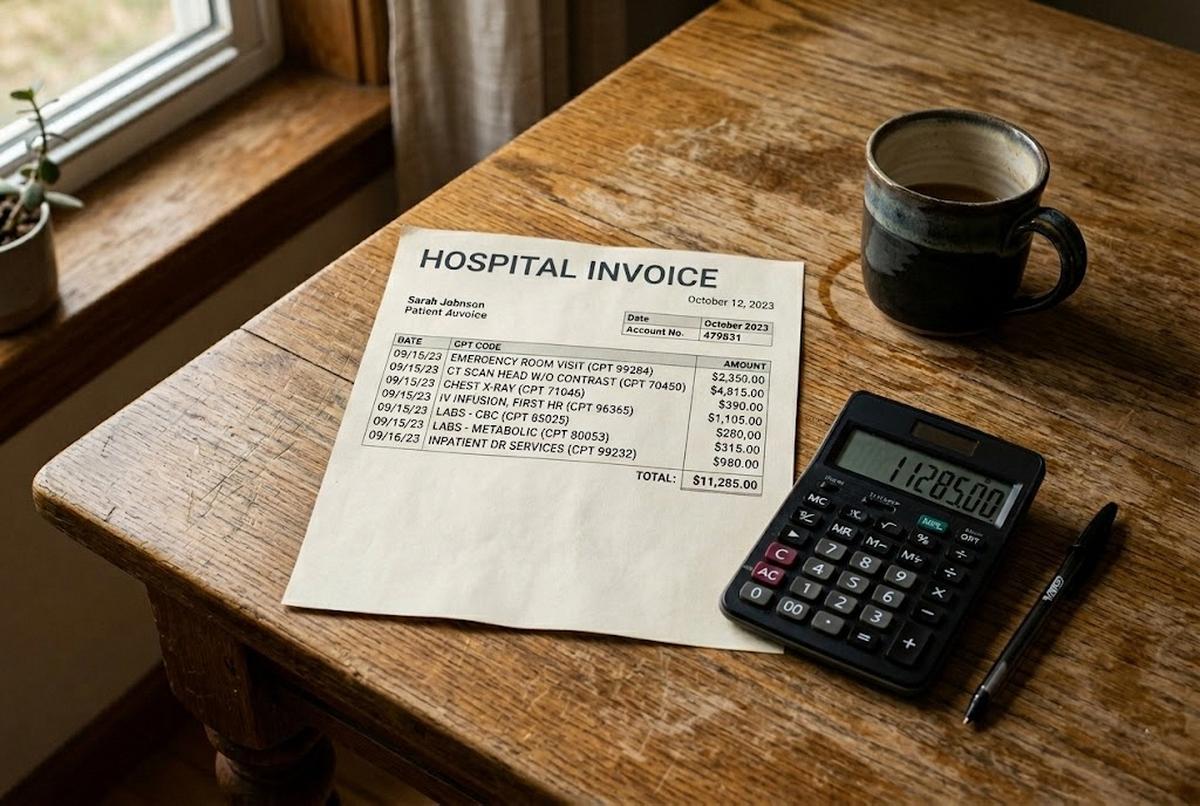
A neighbor of mine, a retired electrician named Russell, handed me a hospital bill last fall for $14,318. He'd had a two-night stay at a hospital in Bridgeport after a fall on his back porch. The summary statement called it "Inpatient Services." That was the entire description. Two nights, $14,318, no breakdown. I asked him to call the hospital and request an itemized bill with CPT codes. The new statement, when it arrived three weeks later, ran 11 pages. The first error I found was on page two: a charge of $487 for a chest X-ray that had been ordered, then cancelled when the doctor changed his mind. The second was a $1,240 charge for a private room. Russell had been in a shared room the entire stay. We were 20 minutes in and we'd already found nearly $1,800 in charges that didn't belong.
This happens constantly. Estimates of how many hospital bills contain at least one error vary widely, and none of them is an official figure. There is no federal error-rate statistic — neither the CFPB nor the FTC publishes one, so be wary of any bill-error percentage that claims a federal source. What the CFPB has documented, repeatedly, is inaccurate medical bills flowing into collections and onto credit reports. The odds are not in the hospital's favor when a careful person actually reads the bill. One caution if you have Original Medicare: for a covered inpatient stay of up to 60 days, your share of the hospital's charges is the Part A deductible ($1,736 in 2026), not the individual line items, while doctors' bills fall under Part B, where you generally owe 20 percent. A free SHIP counselor can help you read your Medicare Summary Notice.
What I want to walk you through here is exactly how to read one. Not the vague "negotiate your medical bills" advice you've seen a thousand times. The specific steps. The federal rules that are now in your favor. The four errors that show up over and over. And the phone scripts that actually work.
The Federal Rules That Are Now on Your Side
Two federal rules matter here, and most patients have no idea either one exists.
The first is the No Surprises Act, which went into effect January 1, 2022, and which the Centers for Medicare & Medicaid Services has continued to refine through 2026. The headline provision: a ban on surprise out-of-network bills for emergency care and for ancillary services (anesthesia, radiology, pathology) at in-network facilities. If you went to an in-network hospital and an out-of-network anesthesiologist showed up in the operating room without your knowledge, you cannot be balance-billed. The out-of-network provider has to settle payment with your insurer, through the federal Independent Dispute Resolution process if they can't agree. Read the bill for any out-of-network charge that looks like it shouldn't be there. It may be a No Surprises Act violation, and you can get help or file a complaint through CMS at 1-800-985-3059. If you have Medicare or Medicaid, those programs already protect you from some unexpected out-of-network bills, and the same help line can still assist with a billing problem.
The second rule is the Hospital Price Transparency rule, which took effect January 1, 2021, and was tightened significantly by CMS effective January 1, 2026 (with enforcement starting April 1, 2026). Every hospital is required to post a machine-readable file of its standard charges, including negotiated rates, for all items and services, plus a consumer-friendly display or price-estimator tool covering at least 300 shoppable services. As of the 2026 update, hospitals must now publish median allowed amounts and the 10th and 90th percentile allowed amounts. You can see the real spread between what the hospital charges, what insurers actually pay, and what you might be expected to pay out-of-pocket. The 2026 rule replaces the old "estimated allowed amount" with dollar figures calculated from what insurers actually paid. Penalties for non-compliance run up to $6,277 per day for the largest hospitals (the 2025 inflation-adjusted maximum).
And here's the rule almost nobody knows about: if you have Medicare, federal law (Section 1806 of the Social Security Act) lets you request an itemized statement for any Medicare-covered item or service in writing, and the hospital must send it within 30 days. Whatever your coverage, ask for CPT codes, ICD-10 codes, and unit counts. Your insurer's Explanation of Benefits (EOB) is not an itemized bill. It's a summary. If the hospital sends you a one-page statement that says "Hospital Services: $14,318" and refuses to break it down, that refusal is worth escalating, and for a Medicare patient it breaks federal law. You don't need a lawyer to make this request. You need a phone call and the right phrase.
What an Itemized Bill Actually Looks Like
When the itemized bill arrives, you're going to see a wall of five-character codes next to dollar amounts. These are CPT codes (Current Procedural Terminology), maintained by the American Medical Association. Don't be intimidated. You only need to recognize a few categories.
- Room and board: shown by Revenue Codes on the UB-04 form, not CPT codes. Revenue codes in the 0120s are semi-private (two-bed) rooms, the 0110s are private rooms, the 0200s are intensive care and the 0210s are coronary care. The accompanying CPT codes you may see (99221–99239) are the physician's daily inpatient evaluation-and-management charges, billed separately from the facility's per-day room fee. Room rates vary widely by hospital; your hospital's price-transparency file lists them.
- Lab panels: code 80053 (comprehensive metabolic panel), 80061 (lipid panel), 85025 (complete blood count with differential).
- Imaging: 71046 (chest X-ray, two views), 74177 (CT abdomen and pelvis with contrast), 70553 (MRI brain with and without contrast). Prices for imaging vary widely; compare them with typical charges in your area.
- Emergency department: 99281–99285 (ED visit, low to high complexity). The complexity level is the single most-disputed coding decision on ED bills.
- Pharmacy: usually shown as J-codes (J-codes are HCPCS codes for injectable drugs) or NDC numbers (the 11-digit National Drug Code).
Look up any code you don't recognize at fairhealthconsumer.org, which lets you see typical charges in your zip code. If a charge runs more than 200% of FAIR Health's typical rate for your area, you have a strong negotiation lever.
The Four Errors You're Most Likely to Find
In 35 years of helping clients sort through medical bills (and lately, neighbors at Ring's End hardware store and people in the pew behind me at Christ & Holy Trinity), these are the four mistakes I see over and over.
1. Duplicate charges. Same lab panel billed twice. Same room night listed on two different lines. The same J-code for the same medication on the same day. Hospitals run charge captures from multiple departments (the lab, the floor nurse, pharmacy), and when systems double-record, nobody catches it because nobody is reading the bill the way you should be reading it. Run your finger down the date column. Anything that appears twice on the same date with the same code needs an explanation.
2. Room dates off by a day. This is the single most common error I see. You were admitted Tuesday afternoon, discharged Thursday morning. That's two nights. The bill shows three. The hospital's billing system charges by calendar day, not by 24-hour period, and discharge-day charges sometimes get added when they shouldn't be. Verify against your discharge paperwork and your own memory.
3. Unbundled lab panels. A comprehensive metabolic panel (CPT 80053) includes 14 individual tests: sodium, potassium, glucose, BUN, creatinine, calcium, the works. Hospitals sometimes "unbundle" the panel and bill each component separately, which costs far more than the single panel charge. If you see individual lab tests with codes in the 82000s and 84000s on a day when you also had a panel drawn, that's an unbundling problem. The AMA's coding guidelines explicitly prohibit it.
4. Services not received. This is the one that surprises people most. A medication you refused. A consult from a specialist who walked into the room, said hello, and never came back, billed as a Level 4 consult. A procedure that was scheduled, prepped for, and cancelled. Cross-reference the bill against your discharge summary and your own notes. If you kept any kind of running list during the stay (and I tell every client to do this), pull it out now.
There's a fifth pattern worth knowing about, though it's harder for a layperson to spot: upcoding. That's when the hospital bills for a more complex level of service than was actually provided. A Level 5 ED visit (CPT 99285) when the documentation only supports a Level 3 (CPT 99283). The price difference can be substantial. If you went to the ED for something that resolved in under an hour with a single test, and you see a 99285 on your bill, ask why.
The Phone Calls You're Going to Make
Three calls, in this order. Block out an afternoon. Have the bill, your insurance card, and your discharge paperwork in front of you.
Call 1: The hospital billing department. Not the customer service line. Ask specifically for billing or patient financial services. Get the representative's full name and a direct extension. Open with this: "I'm calling to request a fully itemized bill with CPT codes, ICD-10 codes, and unit counts for my account. I also want to dispute several charges and request a line-item review." If they push back, say: "I understand Medicare patients have the right to an itemized statement under Section 1806 of the Social Security Act, and I'll follow up in writing. Please confirm in writing that the itemized bill is being sent." Then list the specific charges you're disputing, by line and date. Document everything. Most hospitals will pause the bill from going to collections during a documented dispute, but you have to ask. Use this exact phrase: "Please place this account in dispute status while the review is pending."
Call 2: Your insurer's claims department. Have the EOB in front of you. Walk through any line where the hospital's bill doesn't match the EOB. Ask: "Why was this service denied?" or "Why was this service paid at out-of-network rates when the facility is in-network?" If the answer involves a coding decision, ask the insurer to file a coding review with the hospital. Insurers have leverage hospitals don't take seriously when an individual patient calls.
Call 3 (only if needed): A patient advocate. Most hospitals employ a patient financial advocate or financial counselor whose job is, in theory, to help you. In practice they're a mixed bag. But they have authority to write off charges, set up payment plans at 0% interest, and apply hospital charity-care policies most patients never hear about. Ask explicitly: "Does this hospital have a financial assistance policy, and what is the income threshold for full or partial write-off?" Nonprofit hospitals are required by IRS rules (specifically Section 501(r) of the tax code) to have a written financial assistance policy and to publicize it. They often don't.
When to Bring in a Professional
If the bill is over $10,000, or if the hospital won't return your calls, or if you're dealing with this on top of grief or recovery, hire a medical billing advocate. Some advocates charge a percentage of what they save you and others charge by the hour, so get the fee in writing before you sign anything.
I tell clients: the math works whenever the bill is large enough that the advocate's fee is worth it. For a $4,000 bill, do it yourself. For a $40,000 bill after a hospitalization, get help.
Look for credentials such as Board Certified Patient Advocate (BCPA, from the Patient Advocate Certification Board) or membership in the Alliance of Claims Assistance Professionals (ACAP). Verify the credential. Anyone can call themselves an advocate.
A Quick Word About Time Limits
Dispute the bill in writing as soon as you spot a problem. The sooner you object, the more leverage you keep — and the easier it is to get an account placed in dispute status before it ever moves toward collections. Once the bill is referred to a collections agency, your leverage drops sharply and your credit can take a hit.
A note on medical-debt credit reporting in 2026: the three major credit bureaus (Equifax, Experian, TransUnion) voluntarily stopped reporting paid medical collections in July 2022 and medical collections under $500 in April 2023, and they wait a year before an unpaid medical collection appears. A separate CFPB final rule (issued January 2025) that would have barred ALL medical debt from credit reports was vacated by a federal court in July 2025. The broader federal rule is not in force. Don't count on it as a backstop — dispute fast through the hospital instead.
What to Do This Week
If you've got a hospital bill sitting on the kitchen table right now, or one stuffed in a drawer because you couldn't bear to look at it, here's the order of operations.
- Pull it out. Today.
- Call the hospital and request the fully itemized bill with CPT codes. Use the exact phrase from above.
- While you wait for the itemized bill (allow 7–14 days), pull your EOB from your insurer's portal. Print it.
- When the itemized bill arrives, compare line by line to the EOB. Mark anything that doesn't match.
- Look up unfamiliar CPT codes at fairhealthconsumer.org. Compare charges to typical rates in your zip code.
- Make the three phone calls. Document each one.
- If the bill is large or the hospital is stonewalling, hire an advocate.
Russell got his $14,318 bill knocked down to $9,460. A reduction of $4,858, or roughly 34%. It took him about six hours of work spread over three weeks. He told me later that the hardest part wasn't the phone calls. It was forcing himself to open the envelope.
That's usually the hardest part. Once you've opened it, the rest is just arithmetic and patience. You've handled harder things than this. And you don't have to do it alone. Between the federal rules, the insurer's claims department, and the advocates who do this for a living, there's more help available than you'd guess. Most of it is free. All of it starts with the phone call you've been putting off.
Make the call.
For more on the surrounding decisions families face when a parent's medical costs start adding up, our pieces on how to talk to your parents about their finances, what long-term care insurance actually covers, the Medicare Part D out-of-pocket cap ($2,100 in 2026), and the real cost of aging in place all build on the same idea: read the paperwork, ask the questions, and don't pay a dollar more than the rules say you owe.