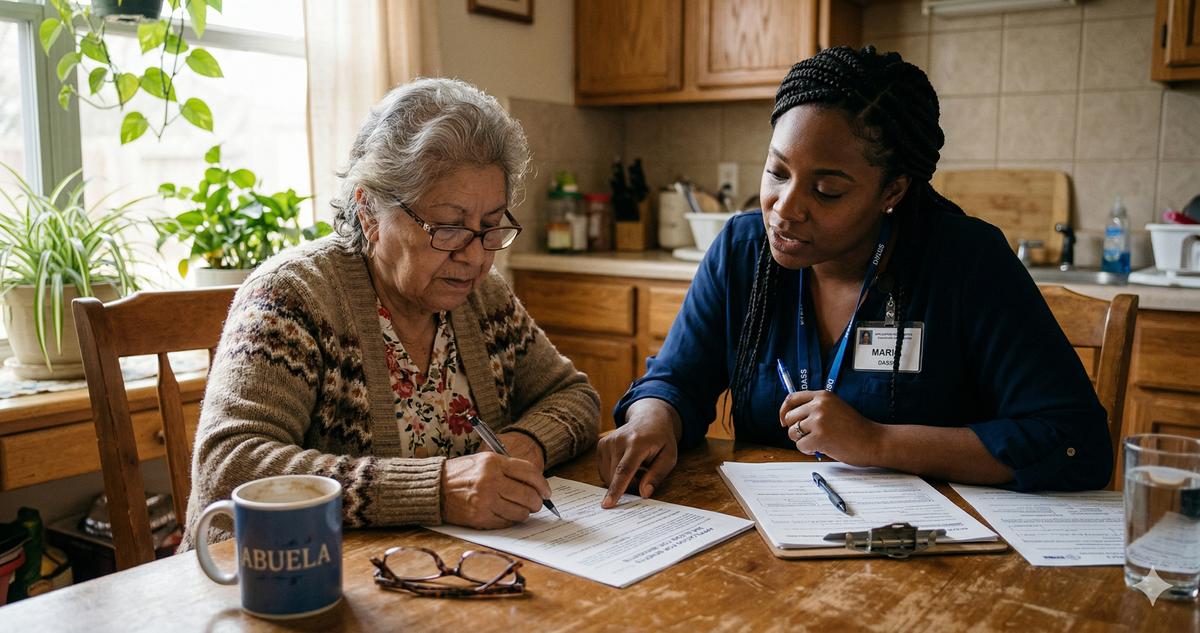
The call came at 4:40 on a Thursday afternoon, which is when these calls always seem to come. Marlene was standing in the admissions office of a skilled nursing facility outside Wallingford, pen in hand, her mother in a wheelchair beside her, reading me a paragraph off page nine. The paragraph used the phrase "Responsible Party." Under it sat a line for Marlene's signature.
She asked me one question. "If I sign this, am I on the hook for my mother's bill?"
I told her to put the pen down.
Let me be direct about this, because the fear behind that question is the entire reason I'm writing this piece. Federal law flatly prohibits a nursing home from making you personally guarantee your parent's bill as a condition of letting your parent in. Federal law also permits something that looks almost identical on the page and is perfectly legal. The gap between those two things is about forty words of regulation, and families have lost houses inside it. (What follows is general information, not legal advice. Before you sign a nursing home admission agreement, have an elder law attorney in your state read it.)
What the Regulation Actually Says
I pulled the current text myself rather than trust somebody's summary, because summaries of this rule are exactly where the trouble starts.
The provision is 42 CFR § 483.15(a)(3). Its first sentence deserves to be taped to your refrigerator:
"The facility must not request or require a third party guarantee of payment to the facility as a condition of admission or expedited admission, or continued stay in the facility."
Read it again, slowly. Not "may not require." Must not request. A facility is not allowed to even ask you to personally guarantee the bill in exchange for a bed.
The same paragraph then carves out an exception, and the exception is where the confusion lives:
"However, the facility may request and require a resident representative who has legal access to a resident's income or resources available to pay for facility care to sign a contract, without incurring personal financial liability, to provide facility payment from the resident's income or resources."
Five words in there do all the work: without incurring personal financial liability. (I keep a printed copy of the paragraph in my briefcase. Maggie thinks carrying a piece of the Code of Federal Regulations around is a strange habit for a grown man. She is correct.)
Most of this comes from Congress. The ban on requiring a third party guarantee sits in statute at 42 U.S.C. § 1395i-3(c)(5)(A)(ii) on the Medicare side and 42 U.S.C. § 1396r(c)(5)(A)(ii) on the Medicaid side, both added by the Nursing Home Reform Act, part of the Omnibus Budget Reconciliation Act of 1987 (Pub. L. 100-203). That half has been on the books since the Reagan administration.
The word request is newer, and it is not Congress's. Until October 2016 the regulation also said only "must not require." The rewrite that took effect that month added "request or require," which is why the sentence you can quote today reaches further than the statute underneath it. It is worth knowing which half is which, because it changes what you are pointing at: a facility that asks you to guarantee the bill is crossing a federal regulation, and a facility that makes the bed conditional on your signature is crossing an act of Congress. Both are worth a call to your state survey agency. Both apply to any facility certified for Medicare or Medicaid, which covers most nursing homes in this country.
Most. Not all. A facility participating in neither program sits outside the federal rule, and that alone is worth asking about on the tour, before anybody is holding a pen.
Representative or Guarantor? The Distinction Doing All the Work
Two signatures. Same pen, same page, wildly different consequences.
Sign as a representative, and you're promising to do something with your parent's money. You're agreeing to pay the facility out of her income and resources, assuming you have legal access to them, usually as her agent under a durable power of attorney, or as a trustee, or as her Social Security representative payee. You're a conduit. Her deposit comes in, the facility gets paid, you make sure the plumbing works. Your own checking account never enters the picture.
Sign as a guarantor, and you're promising something else entirely: that if her money runs out, or her Medicaid application gets denied, or the billing office decides $19,000 is outstanding eighteen months from now, they can come after you. Your wages. Your accounts. Your house.
The first is ordinary and legal. The second is what federal law forbids a facility from demanding as the price of admission. Actually, let me correct myself on the first one: it isn't merely permitted. It's the exact arrangement the regulation was written to preserve, which is why refusing to sign anything at all is the wrong instinct too.
Facilities have a legitimate interest here, and I want to be fair about it. If an adult child controls her mother's checkbook and simply doesn't pay, the home is delivering care for free while the money sits in an account nobody will touch. The regulation accounts for that. It permits the facility to require the person with legal access to those funds to commit to paying from those funds. What it does not permit is converting your mother's debt into your debt as a condition of her getting a bed.
And a great many admission agreements blur the two, sometimes carelessly and sometimes not. The signature line says "Responsible Party." The paragraph above it talks about payment from the resident's resources, which is fine. Then a sentence three pages later says the responsible party is jointly and severally liable for all charges, which is not. Both statements live in the same document. If you read only the paragraph next to the line where you sign, you will never see the second one.
The Words to Look For Before You Sign
Two phrases, mainly. Federal regulators flagged both when they looked at this practice, and they are what to watch for when the packet lands in front of you.
"Responsible party." It isn't a defined legal term with one fixed meaning, which is precisely why it appears everywhere. In some agreements it means what the regulation permits: a person handling payment from the resident's own funds. In others it's the on-ramp to personal liability. The label itself tells you nothing at all. The definitions section tells you everything, so go find the definitions section.
"Joint and several liability." Dry, lawyerly, and the most expensive four words in the packet. Joint and several means each person who signed can be pursued for the entire balance rather than a share of it. Not half. All of it. Attached to your signature line, that phrase is a personal guarantee wearing a good suit.
While you're in there, check one more thing: whether the document states the capacity you are signing in. A signature line with your name and nothing else beside it is ambiguous, and ambiguity in a contract is never the family's friend.
Photograph every page you're asked to sign. Every page, including the ones you're told are "just the standard part." Facilities routinely hand families the signature pages and keep the rest, and you cannot argue later about a document you don't have a copy of.
It Isn't Only About Admission Day
"They already have my mother. Can they make me sign now?"
The regulation answers that one directly. The prohibition covers a third party guarantee as a condition of admission, of expedited admission, or of continued stay. Continued stay is the phrase to hold onto. A facility cannot lawfully wait three months, hand you a revised agreement, and let you believe your mother's bed depends on your personal signature. Same rule, later date.
In my experience this arrives as a friendly phone call from a billing office rather than as a form. Small ask, warm tone, enormous consequence. Ask for anything they want signed to be sent to you in writing, and send it to a lawyer before it comes back with your name on it.
Why This Keeps Happening
On September 8, 2022, the Consumer Financial Protection Bureau and the Centers for Medicare & Medicaid Services announced joint action against illegal nursing home debt collection targeting family members. Not residents. Their children.
The same day, the CFPB issued Consumer Financial Protection Circular 2022-05, "Debt collection and consumer reporting practices involving invalid nursing home debts," which ran in the Federal Register on September 20 at 87 FR 57375. Its point was blunt: debt collectors and credit reporting companies can violate the Fair Debt Collection Practices Act and the Fair Credit Reporting Act by pursuing family members for nursing home debts invalid under the Nursing Home Reform Act.
That circular is no longer in force. On May 12, 2025, the CFPB withdrew dozens of its guidance documents in a single action, and Circular 2022-05 was on the list. Here is what that does and does not mean. It does not change the rule that protects you, which lives in federal regulation and is the passage quoted at the top of this piece. It does not repeal the Fair Debt Collection Practices Act, and a collector pursuing a debt you never lawfully owed still has an FDCPA problem. What it removes is the agency's published statement saying so, which is the sort of thing a lawyer cites in a letter. So the protection is intact and the paper trail behind it is thinner. A debt never lawfully yours does not become yours because a collection agency bought the file.
The CFPB's issue spotlight on nursing home debt collection, published that same month, lays out the machinery without any drama at all. Once a nursing home has a court judgment against a family member, it can garnish that person's wages or foreclose on their home. In the announcement that accompanied the report, the Bureau said caregivers had been subjected to garnishment and had even lost their homes over debts of exactly that kind.
What stayed with me is the account inside the report itself. A daughter was told her mother's Medicaid needed reinstating, filled out the forms, and heard nothing for months — then learned it had never been reapproved and that she was suddenly on the hook. Her mother died on October 3, 2020. Two days before that, she opened mail saying the nursing home was suing her personally for close to $80,000.
"I never had time to grieve. I kept so much inside; the stress was unbearable. I thought, I won't be able to afford my mortgage — I am definitely going to lose my house."
She had not borrowed a dollar. She had signed an admission packet.
The money explains the pressure. Nursing home care is staggeringly expensive. The CFPB report put the median annual cost of a single room at $108,405 back in 2021; CareScout's 2025 Cost of Care Survey, released in March 2026, puts a private room at $355 a day, or $129,575 a year, with a semi-private room at $315 a day, or $114,975. Meanwhile Medicaid is the primary payer for 63% of nursing home residents nationally, according to KFF's analysis of federal survey data for 2025. When a Medicaid application stalls, or gets denied over a transfer nobody thought about during the look-back period, somebody is holding an enormous unpaid balance. The adult child whose signature is already in the file is the easiest name on that file to chase.
A Question From the Workshop
At the Westport Senior Center last fall, halfway through a session on what long-term care insurance actually pays for, a retired toolmaker from New Britain named Warren raised his hand and said he had signed something at his wife's nursing home two years earlier and had, in his words, no idea what it was.
He had the packet in his car. He went out and got it during the coffee break, and we spread fourteen pages across a folding table while people refilled their cups around us. Page six defined "Responsible Party" as the person arranging payment from the resident's funds. Page eleven made that same responsible party liable for "any and all charges." Warren had signed both.
Nothing bad ever happened to him. His wife's Medicaid came through, the bills got paid, no one came after him. He was lucky, and luck is not a plan. That afternoon he wrote down the number for his state's long-term care ombudsman and asked the facility for an amended agreement, and they produced one without an argument. It took one letter. Two years of exposure, undone by one letter!
Six Things You Can Do at the Admissions Desk
- Ask for the complete agreement, all pages, before you sign anything. Then ask for your own copy of what you signed, that day, not "in the mail."
- Find the definition of "responsible party" in the document. If the definitions section describes anything beyond paying from the resident's own income and resources, you've found the problem.
- Say no to the personal guarantee. You can refuse to sign language making you personally liable, and the authority for that is not agency guidance somebody can withdraw. It is the regulation quoted earlier, 42 CFR 483.15(a)(3) — the one worth taping to your refrigerator. Say the words "third party guarantee" out loud in the admissions office. Admission is not supposed to hinge on it.
- Ask for the language to be struck. Not rewritten later, not "we'll note it in the file." Struck, initialed by both sides, on the copy you take home.
- Sign in a representative capacity if you have one. Signing as an agent under a power of attorney, committing to pay from your mother's resources, is the arrangement the regulation expressly allows. If a bank has ever given you trouble over that document, my piece on what to do when a bank refuses a power of attorney covers the fix.
- Get an elder law attorney to read the contract. An hour of a lawyer's time against a six-figure annual bill is not a close call. Ask early, during your tour and question list, not on move-in day when everyone is exhausted.
I wish I could tell you it's simpler than this. It isn't. But six steps is a manageable list, and the whole thing is finishable in an afternoon.
Who to Call If Something Has Already Gone Wrong
- Your State Nursing Home Survey Agency. Every state has one, and CMS publishes the contact list at cms.gov/medicare/health-safety-standards/quality-safety-oversight-general-information/contact-information. A facility requiring a third party guarantee as a condition of admission is a regulatory violation, and the survey agency is the office that investigates it.
- The Long-Term Care Ombudsman program. Free, advocates for residents and families, and reachable through the National Consumer Voice at theconsumervoice.org/get-help. My own view after 35 years: the ombudsman is the single most underused resource in long-term care. Call them!
- The Consumer Financial Protection Bureau. If a collector is pursuing you for a relative's nursing home debt, file at consumerfinance.gov/complaint/ or call (855) 411-2372, or (855) 729-2372 for TTY/TDD. The phone line runs 9 a.m. to 6 p.m. Eastern, Monday through Friday, excluding federal holidays. Their own estimate: the online form takes 7 to 10 minutes, the phone call 25 to 30.
- Your state attorney general. Find yours through the National Association of Attorneys General at naag.org/find-my-ag/, or usa.gov/state-attorney-general.
Write down dates, names, and what was said. A dated note made the same week is worth more than a confident memory made a year later, a lesson I learned the expensive way reviewing my own client files. That habit is the same one I recommend for checking a hospital bill line by line, and for the same reason: the paper trail is what wins.
Where This Leaves Marlene
She didn't sign that afternoon. She asked the admissions director for the full agreement, took photographs of all of it in the parking lot, and emailed it to an elder law attorney in Stamford that night. The attorney found the guarantee language on page fourteen, in a section headed "Miscellaneous," and asked the facility to strike it. They struck it. Her mother moved in the following Tuesday, on schedule, with nobody's house on the line.
That's the part worth remembering. Marlene's mother was admitted anyway. The facility wanted the resident and wanted the payment arrangement, and it had no lawful claim to Marlene's own money in the bargain.
Your parent's bill is your parent's bill. Federal law has said so since 1987. Read every page, ask what your signature actually means, refuse the guarantee, and let a lawyer look at the contract before it's signed rather than after.
Put the pen down. It costs you nothing, and it may save you everything.