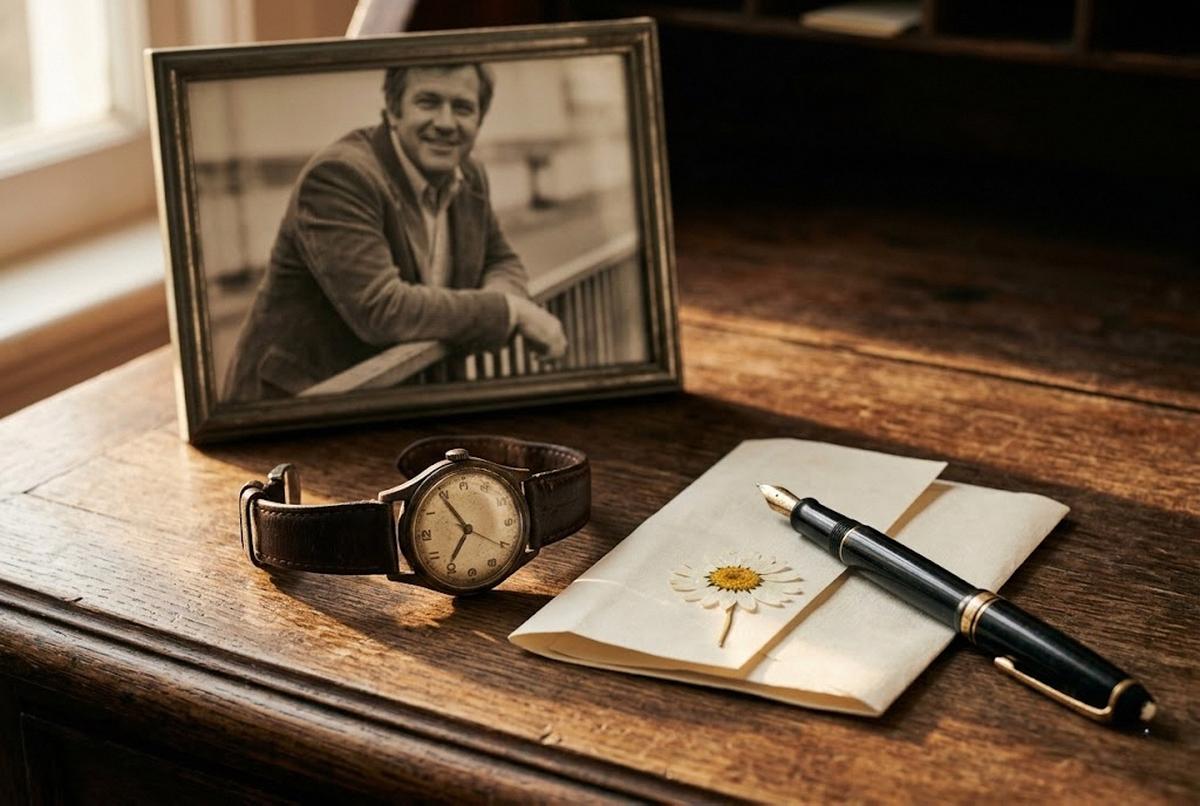
Last spring I painted the den a color called Naval. It is, as the name suggests, a navy. Frank walked in, looked at the walls, looked at me, and said, "Did you tell me you were doing this?" I had. Three times. Once at dinner, once in the car on the way back from Costco, and once while he was watching golf, which doesn't count.
It was the third color that room had been in eleven years. First it was a beige that the previous owners called Accessible Beige, which is Sherwin Williams 7036 and which everybody in Scottsdale has on at least one wall because their realtor told them to. Then I tried a sage that looked lovely in the swatch and like hospital scrubs on the actual wall. Now Naval. Naval is staying. I have decided.
Here's the thing about decorating a house in your seventies: nobody is coming to give you points for getting it right the first time. You've already done the open-concept, the gray-on-gray, the live-laugh-love phase you don't want to talk about. You can paint a room three times if you feel like it. The house is paid off. The kids don't live here. The only person whose opinion technically matters is sitting in the brown leather La-Z-Boy in the next room, and his opinion is "either one is fine."
The HGTV Trap, and Why You Can Ignore It
I like Property Brothers as much as the next person. I have opinions about which house the buyer should have picked (number two, obviously, the kitchen). What I will not do is watch one of those shows and then decide my perfectly functional 1990s bathroom requires $42,000 of subway tile and a freestanding tub I cannot get out of.
The people on those shows are 34, refinancing, and being filmed. None of those things apply to me. The renovations they undertake are designed for resale, which is fine if you're selling and a peculiar form of self-punishment if you are not. Frank and I are not selling. We are dying in this house, eventually, hopefully a long time from now and in our sleep. The kitchen does not need quartz waterfall counters for that to happen.
What the renovation shows never tell you is what actually changes in a room when you're 72, and it isn't the cabinetry. It's the lighting. The contrast on the stair treads. Whether the rug stays put when you walk on it or slides sideways like a getaway car. These changes are not exciting. They will not get you on television. They will, however, keep you upright and able to read the back of a pill bottle, which is the only home improvement that matters at our age.
What You Actually Need: Better Lights, Not New Furniture
My eye doctor told me at my last checkup that the amount of light a 70-year-old needs to read comfortably is roughly three times what a 20-year-old needs. He said it like it was a fun fact. I said it explained why I had been falling asleep over Anne Tyler novels for the better part of two years. I was not sleepy. I was in the dark.
Lighting is the single biggest decorating move available to people our age, and it's also the cheapest. A decent floor lamp at Wayfair runs $80 to $200. IKEA has the Skurup for under $40 if you don't mind a little assembly and the particular flavor of marital tension that comes with reading IKEA instructions together. Target's Threshold line does a passable arc lamp for around $100. None of these will appear in Architectural Digest. All of them will let you finish a paperback without squinting.
A few rules I've worked out the hard way:
- Two lamps in a room, minimum. Overhead lighting alone makes everyone look like they're being interrogated.
- 800 to 1100 lumens for a reading lamp. Anything labeled "mood lighting" is for people in their thirties who can still see in the dark.
- 2700K to 3000K color temperature. Warm white. The bluer stuff (4000K and up) is for garages and operating rooms.
- Put a lamp on a timer or a smart plug so the room is already lit when you walk into it at night. Tripping in the dark is how you become a hospital story.
Frank, who spent forty years as a civil engineer and is therefore physically incapable of accepting a fact without verifying it, took a light meter app out on his phone and confirmed that our living room read 90 lux at my chair. The recommended level for reading is 300. By the numbers, our living room was a cave. Two lamps and a bulb upgrade later, for under $140, the room is now a place I can finish a book in.
Paint, and the Sherwin Williams vs. Benjamin Moore Question
A gallon of decent paint is $50 to $75. A full room, primer and trim included, runs $400 to $800 in materials if you do it yourself, or $2,000 to $4,000 if you hire someone, which I increasingly recommend because climbing a ladder at 72 is how you find out what a fractured hip feels like.
I buy Benjamin Moore. I will not be talked out of it. Sherwin Williams has its partisans and I do not begrudge them their loyalties, but Benjamin Moore covers better, the color cards are more honest about what the paint will actually look like on a wall, and the Aura line is washable in a way that matters when you have a husband who eats peanut butter toast standing up.
The one thing I will say about paint that nobody told me until I'd already made the mistake twice: bring the swatch home and tape it to the wall for at least three days. Look at it in morning light, afternoon light, lamp light, and that gray hour right before sunset that flatters absolutely no color ever invented. A green that looked sophisticated under the fluorescents at the paint store can look, in your actual living room, like a hospital cafeteria. Ask me how I know.
Avoid the all-beige, all-greige, all-tranquil-everything palette that home stagers love. It's pleasant in a model home. It is the color of nothing in your actual life. A house should look like somebody lives in it.
The Marie Kondo Problem at 70
I read Marie Kondo's book in 2016, like everybody else. I thanked a pair of shoes. I folded a shirt in a way that the shirt did not appreciate. I gave it an honest try.
Here's where the Kondo system breaks down at our age: the joy filter is reasonable when you're 32 and sorting through the things you bought at Anthropologie in your twenties. It is not the right filter at 72. By now, the objects in your house aren't just things you bought. They're the bowl your mother served Christmas oranges in. The lamp from your first apartment with Frank. A book Patrick gave you in 1991 with a note in the front that you cannot bear to throw away even though you'll never read the book again.
Those things don't produce joy, exactly. They produce something more complicated. The right filter at our age is: would I miss this if it were gone? Would I want one of the kids to have it someday? Is the memory worth the dust?
Most of the time, the answer is no, and the thing goes. But sometimes the answer is yes, and Marie Kondo can keep her opinions to herself.
If you want practical help working through the actual question of what stays and what goes, the downsizing piece I wrote goes through the system that worked for us when we left Wilmette. The short version: keep the things that hold a story, lose the things that hold dust.
Where to Actually Buy Things, on a Budget
My daughter Carrie, who is an interior designer in Chicago and who is therefore constitutionally unable to walk into a room without rearranging it, taught me most of what I know about buying furniture without spending West Elm money. The list, in rough order of usefulness:
- Facebook Marketplace. Local pickup, cash, and you will find a vintage Persian rug for $200 that retails for $1,800 at the rug store on Scottsdale Road. The trick is to search at odd hours and to be willing to drive thirty minutes for the right piece.
- Estate sales. The good ones are listed on EstateSales.net. You go on the second day, when prices drop 50 percent. You go in the afternoon. You bring cash. You leave with a brass lamp that somebody's grandmother owned, and you give it a new life. Trudy in my book club furnished her entire dining room this way and it looks like a Nancy Meyers movie set.
- Goodwill, but selectively. The Scottsdale Goodwill on Shea has, on a good day, mid-century pieces that the volunteers don't know they should be charging more for. The trick is to go often. Most days there's nothing. Once a month there's a $40 walnut credenza that would be $1,200 at a vintage store on Roosevelt Row.
- Chairish, for the slightly upmarket find. Vetted vintage, marked up but not insane. Best for one statement piece you don't want to drive across town for.
- IKEA and Wayfair, for the boring stuff. Bookcases, basic side tables, anything you don't expect to keep for thirty years. Do not buy upholstered furniture here. Upholstery is the thing it's worth paying for.
The single best piece of advice Carrie ever gave me was this: a $200 vintage rug from somebody's grandmother's house beats a $1,200 new rug from anywhere, nine times out of ten. The wool is better. The pattern was designed by a person, not a focus group. And it already looks like it belongs in a house instead of a showroom.
The Chair Question, and Other Marital Negotiations
Frank has a chair. It is brown leather. It is older than two of our grandchildren. It is, by any reasonable design standard, an eyesore — the cushions are sprung in the front from forty years of sitting, the arms are darker than the seat from forty years of resting, and it does not match a single other thing in the room.
I have suggested, gently, that we replace it. Less gently, that we reupholster it. Once, that we move it to the spare bedroom "just for a while" to see how the room feels without it.
Frank, in his calm civil-engineer way, has said no every time. Not angrily. Just no. The chair stays. The chair is where he sits when he watches the Cubs lose. The chair is where he sat the night Patrick called from Portland to say his marriage was ending. The chair is where he naps on Sunday afternoons with the dog he doesn't admit he loves draped over his feet.
I have come around to the chair. Not aesthetically — aesthetically the chair is still a problem. But the chair is what makes the room ours instead of a magazine spread. A house that contains no ugly beloved object is a house that nobody actually lives in. The chair stays. I've decorated around it.
This is, I think, the real budget tip nobody puts in articles: figure out which battles aren't worth winning, and stop spending money trying to win them.
What My Mother's Apartment Taught Me
When my mother Dorothy died in 2012, I flew to Evanston to clear out her apartment. She had hired a decorator in 2007 — a woman named Nadine who came highly recommended and who, for $14,000, had filled my mother's two-bedroom condo with tasteful neutral furniture, art she did not choose, and throw pillows that did not match anything Dorothy had ever owned in her life.
I walked through those rooms after she died and I could not find her in any of them. The mother who clipped recipes from Good Housekeeping and saved every Christmas card her grandchildren ever sent. The mother who had a needlepoint of "Bless This Mess" hanging in her kitchen for forty years until Nadine, presumably, put it in a closet. None of that woman was in those rooms. The rooms looked like a hotel lobby. The pillows had piping.
What I learned that week, standing in my mother's tasteful sterile apartment, is that a house should be embarrassingly personal. It should have the ugly chair. The needlepoint that says something corny. The framed photo of the grandchildren at the Desert Botanical Garden where Oliver is picking his nose and Lily is making bunny ears behind Jack's head. The wall color you painted three times because you couldn't get it right.
The goal is not a house that a stranger would walk through and call beautiful. The goal is a house that, if you died tomorrow, your children would walk through and recognize as yours. That's the only budget question that really matters. Everything else is just paint.
Mine, for the record, stays Naval.