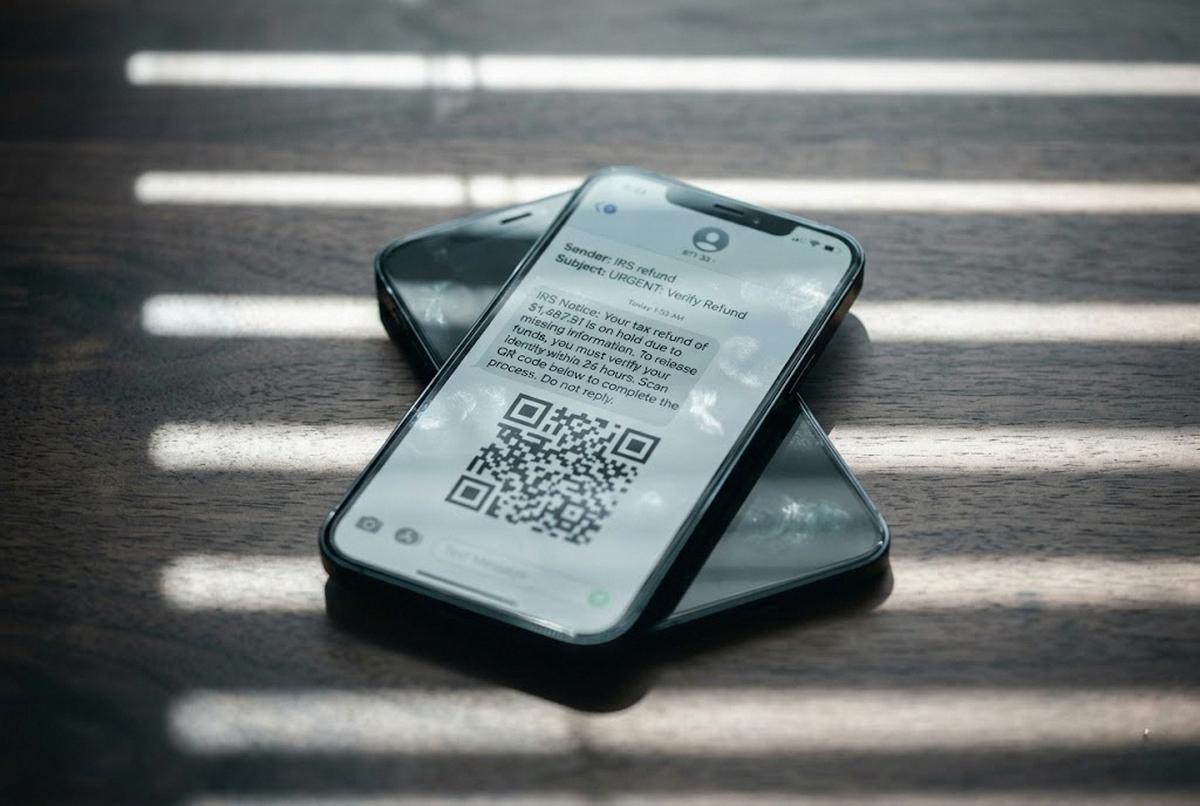
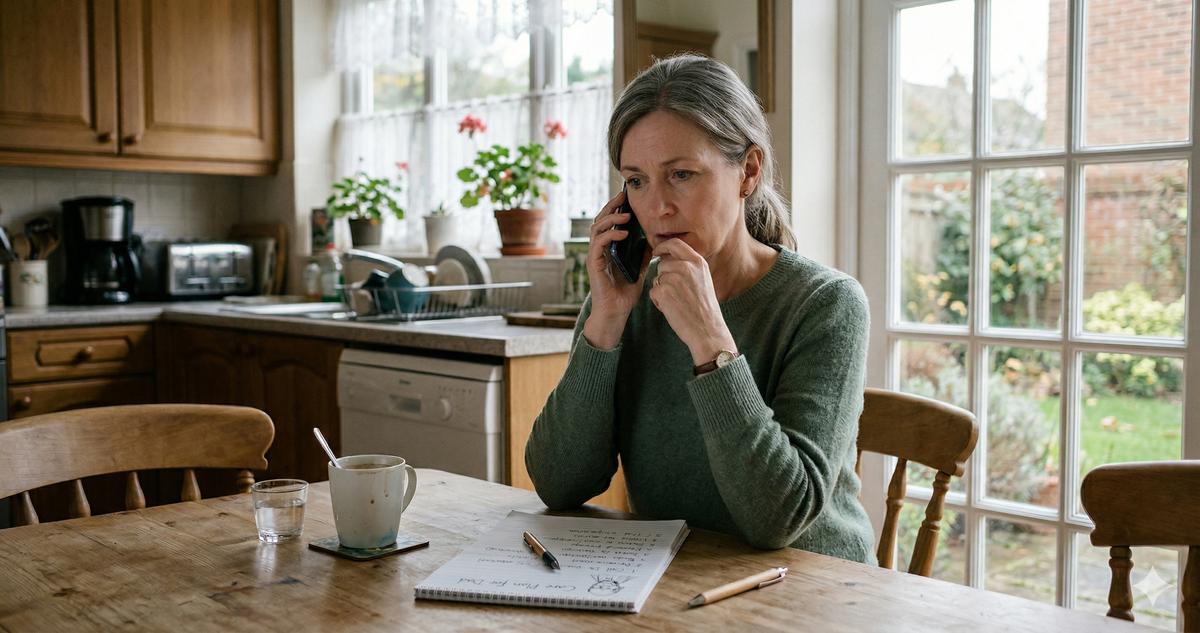
The Sign-Out Clipboard I Walked Past for Two Years
The memory care wing at my dad's facility keeps a sign-out clipboard by the front desk. Name, time out, time back, who you're with. My father isn't in that wing, so for two years I read that clipboard as ordinary paperwork, the same way you'd read a parking sign.
Then one Sunday in February I was signing him back in from a Chickenjoy run, and a woman at the desk was crying. Her father had gone out a side door the night before. Eleven at night, a cardigan, February, Michigan. They found him around four in the morning, a mile and a half away, sitting on a bench at a bus stop that hasn't had a route since 2019. He was fine. He was also very cold, and she was not fine at all.
Her name is Tita Merly. Her father is Lolo Bert. We've talked a lot since that Sunday, and the first real question she asked me, once her hands stopped shaking, was whether there was a GPS tracker for an elderly parent with dementia that would just work, and how fast she could get one on him.
I did not have a good answer that day. I have one now, and it took me most of the spring to get there.
Six in 10 people living with dementia will wander at least once, and many do so repeatedly. That's the Alzheimer's Association's number, from their wandering page, and the sentence just before it carries as much weight: it's common for a person living with dementia to wander or become lost or confused about their location, and it can happen at any stage of the disease. Any stage. Not the late stage, not after some clear warning line somebody hands you.
The Question Every Other Article Skips
Search this topic and you'll get twenty pages of spec lists. Battery life, accuracy in feet, waterproof rating, app screenshots, a star rating out of five. All of it real. None of it the actual decision.
The actual decision is how much your parent has to cooperate for the thing to work at all.
A tracker isn't a technology problem. It's a behavior problem wearing a technology costume. A device reports a location only if it is on the person, powered up, and still there at 11 p.m. when the side door opens. Every link in that chain runs straight through the part of your parent that is the thing failing.
And the crueler piece: whatever makes wandering likely also makes an unfamiliar object on the wrist feel wrong. Lolo Bert took off the first watch Tita Merly tried in about forty minutes. Not stubbornness, not defiance. He didn't recognize it, it was on his arm, so he took it off and set it on the windowsill. Honestly? Anyone would.
So that's the axis I sort these devices by. Three levels of cooperation:
- Full cooperation. Your parent puts it on, keeps it on, and hands it over to be charged. Works when there's still insight, routine, and genuine buy-in.
- Partial cooperation. Visible, but small enough to clip somewhere unremarkable, or it rides in a pocket or a purse they carry everywhere anyway.
- No cooperation at all. It lives inside something they already put on without thinking. Nothing to remember, nothing to accept, nothing to remove.
Match the device to the cooperation level you actually have, not the one you wish you had. Guessing high is how families end up with a $600 gadget in a kitchen drawer and a parent who is still, on some future Tuesday, out walking.
What I'd Buy, and What It Really Costs
Before the table: no affiliate money in this article. Nobody sent me a unit, nobody pays me per signup, and there isn't a tracking link anywhere on this page. A lot of what ranks for this search collects $50 to $150 when you click through and buy. I'd rather tell you the SmartSole runs $658 in its first year and let you decide what to do with that.
Every price below I read off the company's own page on August 31, 2026. Check them again before you buy, because these move.
| Device | Up front | Ongoing | Cooperation needed | How it's carried |
|---|---|---|---|---|
| Apple AirTag | $29, or $99 for a four-pack | None | Low, if you can attach it to something | Keys, wallet, bag, coat pocket |
| Jiobit Smart Tag | $129.99, plus $29.99 pin-lock pouch kit or $15.99 sleeve | $8.33/mo prepaid annually ($99.99/yr), or $16.99/mo | Medium | Pin-lock pouch (key to remove) or fabric sleeve |
| AngelSense | $229 listed, free only with a 12-month contract plan | $44.99/mo annual, $49.99/mo on a 1-year contract, $64.99/mo month-to-month | Medium | Pinned sleeve worn on clothing, magnetic key to remove |
| GPS SmartSole | $229.00 | $49/mo, $138/quarter, $259/6 months, or $429/yr | None | Hidden inside a shoe insole |
Two footnotes before anybody emails me. AngelSense lists its device at $229 and was, the day I checked, offering it free when you take a subscription plan. Treat that as a live promotion rather than a price, because promotions end and this article won't. Second, the SmartSole's service plan is bought separately from the insole itself, so $229 is the doorway, not the room.
AngelSense: The Most Capable, and the Most Visible
AngelSense is built for special-needs and elopement families — its own page leans heavily on autism, school buses, and children — and dementia families use it for the same reason. It shows in what's bundled: unlimited real-time GPS from an iPhone, an Android phone, or a browser, a 4G SIM embedded in the device so it doesn't lean on your parent's phone, unlimited guardians, unlimited alerts, unlimited geofenced zones, transit tracking, a daily timeline of where the day actually went, and 60 minutes a month of voice calling through the device itself.
That last one is worth pausing on. If your parent is out and confused, you can talk to them through the thing. Not a dot on a map. A voice, saying stay right there, we're coming. For a family that has already had one four-a.m. search, that feature alone can be the whole purchase.
There's also a free onboarding call, which I initially read as marketing fluff and have since changed my mind about. Actually, let me put that more honestly: I dismissed it because I set up hardware for a living. Most families don't, and a scheduled human walking a 68-year-old daughter through her first geofence is worth more than another paragraph of specs.
Now the cost. The subscription is required, and it comes in three shapes: $64.99 a month with no contract and cancel-anytime, $49.99 a month billed monthly on a one-year contract, and $44.99 a month on the Annual Plan paid up front for the year, which is the one AngelSense marks Most Popular. That annual route is $539.88 written in a single check, which is a real number for a fixed income even though it's the cheapest per month.
And here's where I have to correct an assumption I had going in. I expected AngelSense to be the most visible thing on this list. It isn't, quite. The kit ships with a sensory-friendly sleeve, three fasteners, and a magnetic key, and the company's own instructions are to attach it to clothes, inside pockets, or a bag with non-removable pins. That's a pinned pouch a parent can't casually take off — much closer to Jiobit's pin-lock pouch than to a wristwatch. It still has to go on the body each morning, and somebody still has to charge it, so it asks more of you and your parent than a shoe does. But it asks less than I assumed.
Jiobit: Small, Cheaper to Buy, Still Has to Be Worn
Jiobit is owned by Life360, and the Smart Tag is the size of the thing you'd clip to a keyring. It runs $129.99, down from a $149.99 list price, and the subscription is required per device: $8.33 a month if you prepay the year at $99.99, or $16.99 a month if you'd rather not commit.
Per device. Read that twice if both of your parents need one.
It attaches with a pin-lock pouch or a fabric sleeve, and those are sold separately — $29.99 for the pouch kit, $15.99 for the sleeve. Budget for the pouch: it's the one that needs a key to come off, which is the whole point for a parent who removes things. That makes the realistic first year $259.97, not $229.98. A belt loop under a shirt hem. Inside a jacket. It's still worn openly in the sense that it's a foreign object your parent could find and remove, but it's small and quiet about itself in a way a watch isn't. For a parent who still cooperates most days, this is the cheapest honest entry into real tracking.
GPS SmartSole: The One That Asks Nothing of Your Parent
Here's the option I wish somebody had told Tita Merly about in February.
The GPS SmartSole, from GTX Corp and sold under the MetAlert name, puts the GPS unit inside a shoe insole. You trim it to size, drop it in the shoe, and that's the entire interaction your parent ever has with it. Nothing on the wrist. Nothing clipped to the belt. Nothing unfamiliar to notice, resent, and set on a windowsill at forty minutes.
I want to be clear about why this matters so much, because it is the whole argument for a device this expensive. Wandering is not a scheduled event. It happens on the night nobody planned for, and the tracker that saves you is the one already in place, with zero decisions made that evening. A watch requires a decision every morning. An insole requires one decision, once, by you, in your parent's closet.
It comes in two sizes: small, covering men's 3 to 8 and women's 3 to 10, and large, covering men's 9.5 to 13 and women's 10.5 and up. Check the actual shoe before ordering, not the size your mother says she wears.
The device is $229.00 and the service plan is required and purchased separately, in four shapes: $49 a month, $138 a quarter (the site says that saves 6%), $259 for six months (12%), or $429 for the year (27%). Year one, insole plus the annual plan, is $658. Year two is $429. It's the most expensive first year on this list and I'd still put it in front of the AngelSense for a parent who removes things.
The honest limits, since nobody else will say them out loud. It tracks the shoe, not the person, so it covers only the trips taken in that pair. If your dad walks out in slippers, you have a well-tracked pair of empty sneakers by the door. Buy two soles or make that pair the only pair by the exit. It also still needs charging, but the charging happens on your calendar, at night, when the shoes come off anyway, which is a routine you control rather than one your parent has to keep.
About the AirTag, Since Everyone Asks
Every single time this comes up, somebody says: my nephew put an AirTag on his dog, can't I just do that for $29?
You can buy one. It's $29 for a single, $99 for a four-pack, with no subscription ever, and I'm not going to pretend that isn't attractive next to $539 a year.
But look at how it finds things, because the mechanism is the answer. An AirTag has no cellular connection of its own. It doesn't call anybody. It sits there emitting a signal, and it gets located when somebody else's Apple device happens to walk past and quietly relay the position. Apple's pitch for this is that the Find My network "can leverage more than a billion iPhone, iPad, and Mac devices," and that's genuinely a lot of devices.
Now put that in Lolo Bert's February. A bus stop, a mile and a half out, at four in the morning, on a road with no sidewalk traffic. How many iPhones walked past him between eleven and four?
That's the difference between an item finder and a purpose-built safety device. On a crowded sidewalk downtown at noon, an AirTag performs beautifully. On an empty rural road, in a wooded lot behind a subdivision, or at three in the morning anywhere at all, there may simply be nothing nearby to pass the message along. And those are exactly the conditions a wandering search actually happens in.
I'd still buy one. Not as the plan, as the backstop: $29 in the wallet, in the walker bag, in the car. Layers are good. Just don't let the price talk you into calling it the safety net when it's a supplement.
What a Year Actually Costs, Side by Side
Round numbers, first year, cheapest configuration each vendor offers:
- Apple AirTag: $29, once, forever.
- Jiobit: $129.99 plus $99.99 prepaid for the year. $229.98.
- AngelSense: $539.88 on the Annual Plan, with the $229 device free under the current promotion.
- GPS SmartSole: $229 plus $429 annual. $658.
One trap in that list. The free device requires a plan with a twelve-month service contract, and the month-to-month tier is explicitly a no-contract plan — so choosing month-to-month forfeits the free device. That path is $779.88 in subscription plus the $229 device: $1,008.88 for the first year. The flexible option is the expensive one, by a lot.
Year two is where they separate: $0 for the AirTag, $99.99 for Jiobit, $429 for the SmartSole. AngelSense stays at $539.88, because the device was already free the first year — there's nothing left to fall off. What surprised me running these was how close AngelSense and the SmartSole land once you stop looking at the sticker and start looking at the year. About $120 apart in that first year, for two devices that solve the same fear in completely opposite ways. The deciding factor genuinely isn't the money. It's whether your parent will keep the thing on.
What No Tracker Fixes
A tracker tells you where. It doesn't tell you they're in trouble, it doesn't get them home, and it doesn't call anyone for you.
So build the rest of it now, while you're already thinking about it. Get your parent on the local police department's file for at-risk adults, if your county keeps one. Put a laminated card with your phone number in every coat pocket. Tell the two neighbors who are home during the day, by name, what to do if they see him walking. Chimes on the exterior doors cost ten or fifteen dollars and buy you the eleven p.m. you'd otherwise sleep through.
And know which problem you're actually solving. A medical alert system is a different tool for a different night, because it waits on a button somebody has to press, and a person who is confused about where he is will not press it. If your worry is a fall in an empty house rather than a walk out the door, sensors that watch for falls without a camera are the more honest spend. And if the entire conversation is stuck because your mother says she doesn't need any of this, that's its own problem, and I've written about what to do when a parent refuses help.
Five Questions Before You Spend Anything
Answer these on paper. It takes ten minutes and it'll pick the device for you.
- Has your parent ever removed something you asked them to wear? One yes sends you to the SmartSole. Not maybe. Straight there.
- Who's charging it? If the answer is "he will," pick again. If it's you, or an aide, or a nightly routine somebody else owns, a worn device is back on the table.
- Do you need to talk to them, or just find them? Talking is AngelSense. Finding is anything on the list.
- How many people need the app? AngelSense includes unlimited guardians. Jiobit's subscription is priced per device, so two parents means two of everything.
- Can you write one annual check, or does it have to be monthly? AngelSense goes from $44.99 to $64.99 a month depending on your answer — and month-to-month also forfeits the free device, so not committing costs $240 in subscription plus $229 for the hardware. $469, the first year.
That's the whole framework. Cooperation first, features second, price third, and if you do it in that order you will not buy the wrong thing.
What I Told Tita Merly
She went with the SmartSole, and a second pair of the same New Balance sneakers so there's a tracked pair by both doors. Lolo Bert has no idea. That's the point!
I don't have this perfectly figured out, and I'm not going to pretend the anxiety goes away because a dot shows up on your phone. It doesn't. Tita Merly still checks the app at 2 a.m. some nights. But she checks it from bed now instead of from her car, and if you have been driving slow circles around your parents' neighborhood at four in the morning, you already understand what that difference is worth.
If you're on the fence, do question one this weekend. Just that one. Has he ever taken something off? You already know the answer, and the answer picks the device.