I was standing in the yarn aisle at Hobby Lobby last Tuesday, holding a skein of something called "Caron Simply Soft" in a shade the label described as "Autumn Maize," which is a fancy way of saying yellow. Frank was in the car. He'd given me fifteen minutes, which in Frank time means he'd already started his audiobook and mentally moved on with his life.
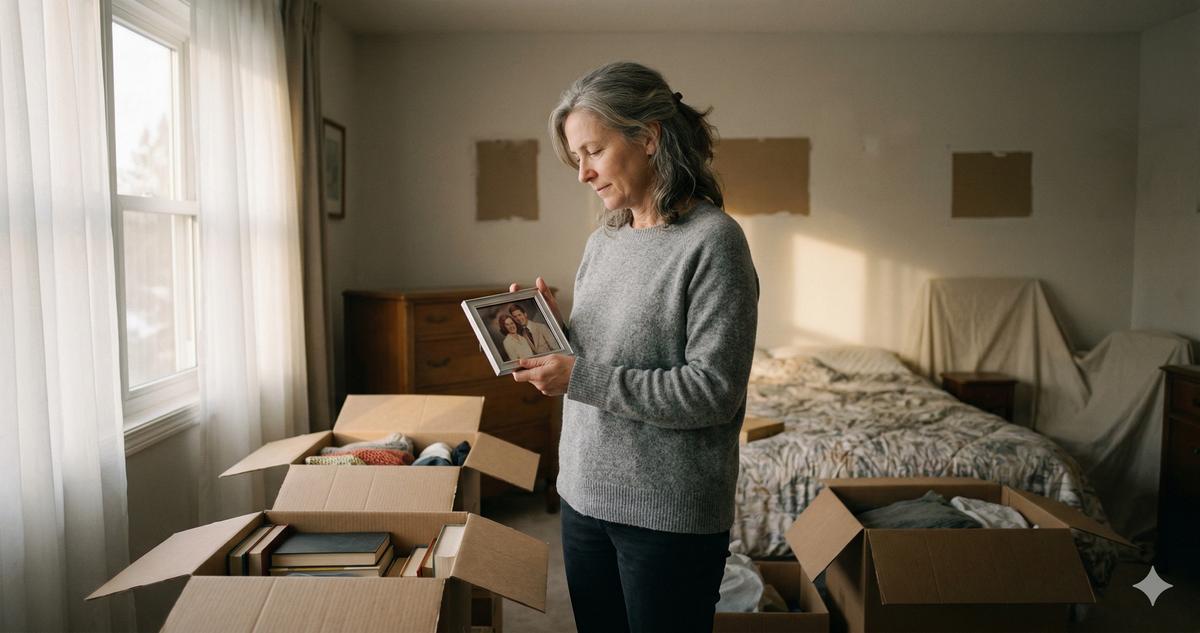
I wasn't there for yarn. I was there for picture frames. But the yarn aisle is right next to the frames, and something about all those skeins lined up by color — sage to emerald to forest — stopped me cold. My mother, Dorothy, used to crochet every evening after dinner, sitting in the kitchen with Johnny Carson on the little TV and a hook moving so fast her fingers blurred. She made afghans for everyone. I have three. Frank has two. Patrick got one for his Portland apartment and immediately covered it with a cat. Dorothy crocheted until she was eighty-four, and her mind stayed sharp as a tack until the very end.
I put the yarn down. Then I picked it back up. Then I Googled "does crafting help your brain" on my phone, right there between the chenille and the cotton blends.
Turns out, it does. And not in a vague, feel-good, "staying busy is nice" kind of way. In a real, peer-reviewed, somebody-actually-studied-this kind of way.
Your Brain on Yarn (and Paint, and Clay)
A 2011 Mayo Clinic study interviewed 1,321 adults ages 70 to 89 and found something that made me put down my phone and stare at the ceiling for a minute: people who engaged in crafting activities — knitting, quilting, pottery — had about 34 percent lower odds of having mild cognitive impairment than people who did those activities once a month or less. Thirty-four percent. That's not a rounding error. That's a significant gap between a crochet hook and a remote control.
The researcher, Dr. Yonas Geda, and his colleagues at the Mayo Clinic published the findings in The Journal of Neuropsychiatry & Clinical Neurosciences. The study controlled for age, education, and sex. The results held. Crafting wasn't just correlated with better cognition — it was independently associated with reduced odds of impairment.
And the research has only gotten stronger since then. A growing body of neuroimaging studies has found that creative activities — visual arts, music, dance, and crafting — are consistently linked to what researchers call "younger-looking brains." The effect appears to scale with practice: the more years you've spent doing creative work, the more resilient your brain looks on scans. Even beginners who take up creative activities later in life show measurable improvements in cognitive flexibility.
Multiple longitudinal studies have found that regular engagement in creative arts is associated with significantly lower rates of cognitive decline over time — with some studies showing risk reductions of 30 percent or more over four-year follow-up periods.
I'm not a scientist. I taught The Great Gatsby for eighteen years, not neuroscience. But even I can read those numbers and think: maybe my mother's crochet hook was doing more than making afghans. Maybe it was keeping her sharp in ways none of us understood at the time.
The Crafts That Work Hardest
So which crafts actually give your brain the best workout? Not all yarn is created equal — wait, actually, that's not quite right. All crafting helps. But different crafts light up different parts of the brain, and some are more demanding than others.
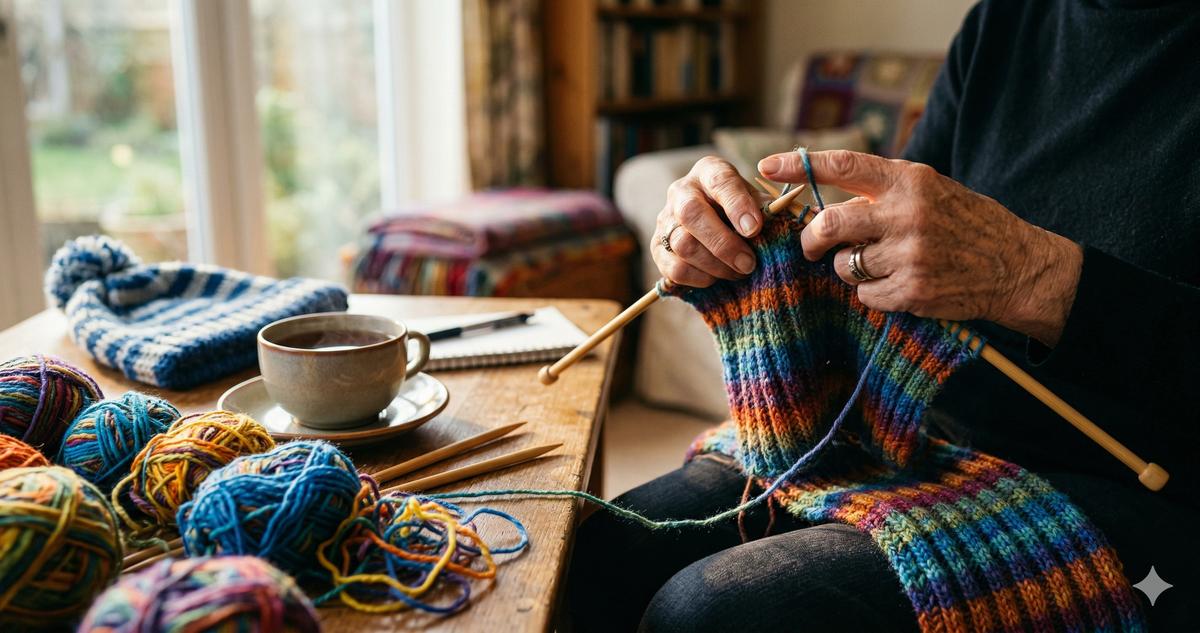
Knitting and crochet require bilateral hand coordination, meaning both hands are doing different things simultaneously. Your left hand tensions the yarn while your right hand manipulates the needle, or vice versa. This engages multiple brain regions at once — motor cortex, prefrontal cortex, cerebellum — and creates neural pathways that strengthen with repetition. The repetitive rhythm also lowers cortisol, the stress hormone, in a way that researchers have compared to meditation. Except you end up with a scarf.
Quilting adds spatial reasoning and geometry to the mix. Cutting fabric into precise shapes, calculating measurements, matching patterns — it's basically math class disguised as something your grandmother did, which is exactly how I would have sold algebra to my sophomores if I'd thought of it in 1992.
Painting and drawing activate the brain's visual-spatial processing and engage fine motor control through brush or pencil work. Watercolor, specifically, demands planning because you can't paint over mistakes the way you can with acrylics. Your brain has to think three steps ahead.
Pottery and ceramics involve tactile feedback, three-dimensional thinking, and bilateral hand coordination. The sensory input from clay — the temperature, the texture, the resistance — sends a flood of information to the somatosensory cortex. Plus, there's the meditative quality of a spinning wheel, which I imagine is lovely if you don't accidentally fling clay across the room, which I'm told happens.
Paper crafts — card making, scrapbooking, origami — combine fine motor precision with creative decision-making. Origami in particular has been studied for its brain health benefits, requiring sequential memory, spatial reasoning, and precise finger movements.
The common thread? Every one of these activities forces your brain to coordinate planning, motor control, visual processing, and creative problem-solving simultaneously. Television asks your brain to sit there. Crafting asks it to show up.
Flow State: The Zone Nobody Talks About
There's a word for what happens when you're forty-five minutes into a knitting pattern and you suddenly realize you haven't thought about your grocery list, your doctor's appointment, or that thing your sister-in-law said at Easter. Psychologists call it "flow."
Flow state — first described by psychologist Mihaly Csikszentmihalyi in the 1990s — is that feeling of being completely absorbed in an activity. Time warps. The internal chatter quiets. You're not relaxing, exactly. You're deeply engaged, but the engagement feels effortless.
Here's the thing about flow: it's protective. When your brain enters a flow state, it reduces activity in the default mode network — the part of your brain responsible for rumination, self-criticism, and that 2 AM replay of every embarrassing thing you said in 1987. For older adults, regular flow experiences have been linked to lower rates of depression and anxiety, better mental well-being, and even improvements in cognitive flexibility.
My book club friend Rosemary, who is 74 and has the patience of a kindergarten teacher on summer break, took up cross-stitch three years ago after her husband passed. She told me she started because she needed something to do with her hands during the evenings. "Now I sit down at seven and look up and it's ten-thirty," she said. "I don't know where the time goes." She paused. "But I know where the sadness goes. It goes quiet."
That stopped me. Because Rosemary wasn't describing a hobby. She was describing a lifeline.
The Group Table Effect
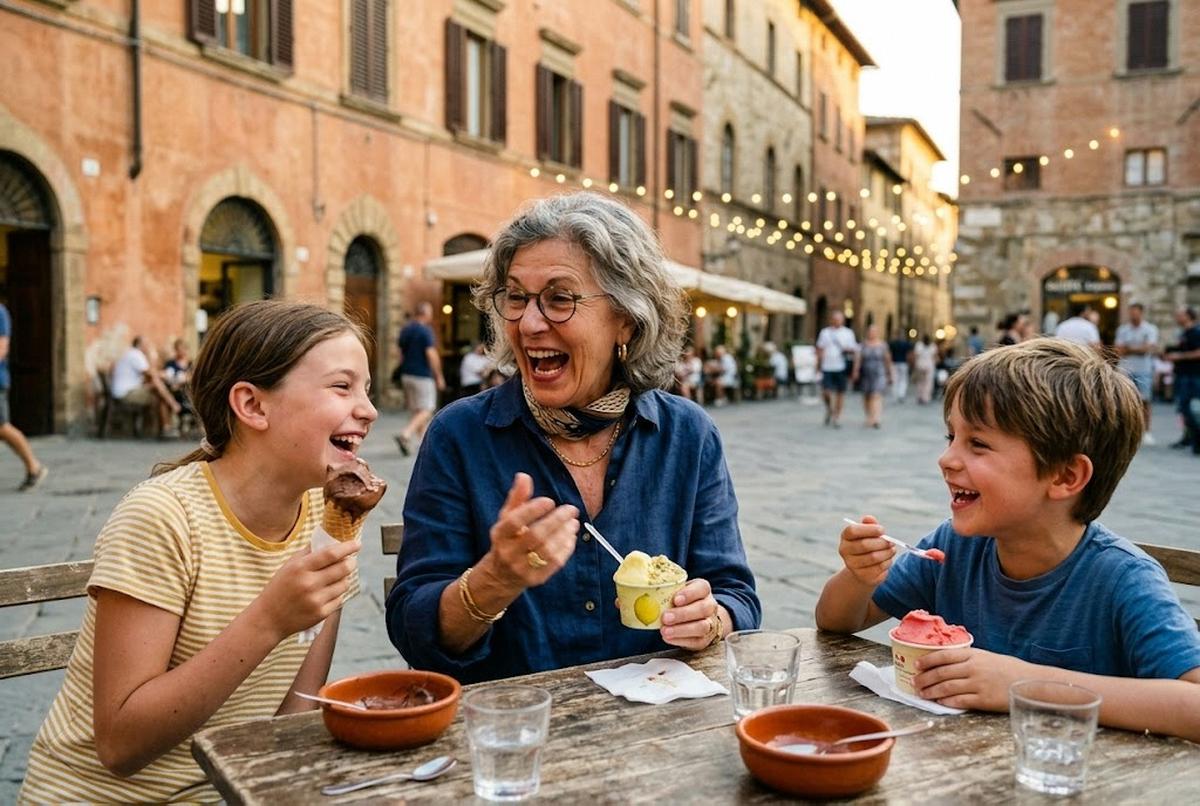
"You should come to my quilting group," said Connie, a woman I met at the Scottsdale Community Center last fall while we were both pretending to be interested in a flyer about estate planning seminars. Connie is 68, wears reading glasses on a beaded chain, and radiates the energy of someone who has strong opinions about thread count.
I said I didn't quilt. She said, "Neither did I until I was 65. Now I'm making a queen-size for my granddaughter and I have friends."
She said that last part — "and I have friends" — like it was the more important half of the sentence. It was. If you're looking for connection after retirement, a craft table is one of the best places to make friends after 60.
Research backs her up. Social isolation is one of the most significant health risks for adults over 60, linked to increased rates of heart disease, depression, and cognitive decline. Crafting groups — quilting circles, knitting clubs, pottery classes — address this directly. They create what sociologists call "low-pressure social environments": you're sitting next to someone, doing a shared activity, and conversation happens naturally. Nobody has to make small talk about the weather because you're both trying to figure out why the bobbin thread keeps jamming.
Research by Dr. Julianne Holt-Lunstad, whose meta-analyses have been cited by the U.S. Surgeon General, found that loneliness among older adults carries health risks comparable to smoking 15 cigarettes a day. Fifteen. And yet we treat a quilting bee like it's optional recreation rather than what it actually is: a public health intervention with snacks.
Crafting communities also exist online now — Facebook groups, YouTube tutorials, Zoom stitch-alongs. For seniors who can't drive or live in rural areas, these digital circles offer real connection. They're not the same as sitting at a table together, but they're not nothing, either. My mother's generation had church basement sewing circles. Ours has a Facebook group called "Crochet After 60" with 47,000 members. Dorothy would have been baffled. She also would have joined immediately, because she never met a pattern she didn't want to argue about. You can feel less alone after retirement without ever leaving your living room — though leaving your living room is still a good idea when you can manage it.
But My Hands Don't Work Like They Used To
The single biggest objection I hear — from friends, from readers, from Frank, who once tried to build a birdhouse and cut a piece of wood at an angle that defied Euclidean geometry — is arthritis. "My hands can't do that anymore."
Fair. Arthritis is real, and I won't pretend a pair of size 2 knitting needles is going to feel great on inflamed finger joints. But the crafting world has adapted, and there are more options than most people realize.
Larger tools change everything. Size 13 or 15 knitting needles with chunky yarn require far less fine motor precision than delicate work. Ergonomic crochet hooks with cushioned, contoured grips — Clover Amour makes a popular set for about $30 — reduce hand strain significantly. Foam tubing, available at any medical supply store for a few dollars, slides over paintbrush handles, pencils, and craft tools to build up the grip.
Adaptive scissors — loop scissors or tabletop spring-loaded scissors — require almost no hand strength. Pre-cut fabric and iron-on adhesive can replace precise cutting and pinning in quilting projects.
Painting is surprisingly accessible. Wide-handled brushes, paint pens, and even finger painting (not just for preschoolers, I promise) work beautifully for people with limited dexterity. Watercolor pencils let you draw dry and then brush water over the marks — easier to control than a loaded brush.
Workspace matters. A table at elbow height, a supportive chair with armrests, bright lighting, and breaks every twenty minutes make a bigger difference than most people expect. One occupational therapist I read about recommends keeping sessions to thirty minutes initially and building up — the same advice you'd give someone starting an exercise program, because that's essentially what this is.
The point isn't perfection. Nobody's grading your pottery. (Well, I might be — old habits.) The point is engagement.
Getting Started Without Spending Your Grandchildren's Inheritance
Crafting doesn't have to be expensive. It can be, obviously — walk into a Joann Fabrics with a credit card and you'll understand what I mean — but the entry cost for most crafts is surprisingly low.
A basic set of knitting needles and a skein of practice yarn runs about $12 at Walmart. Watercolor sets start at $8 for a Prang 16-color pan. Dollar Tree carries craft supplies that are perfectly adequate for beginners. Your local library almost certainly has crafting books and may host free workshops — a growing number of U.S. public libraries now offer some form of creative programming for adults.
Community senior centers are goldmines. The Scottsdale Civic Center Library runs free watercolor classes on the second Thursday of every month. Joann Fabrics and Michaels both offer in-store classes, many under $10. Parks and recreation departments across the country list crafting courses in their seasonal catalogs.
Online, the options are almost overwhelming. YouTube alone has hundreds of thousands of free tutorials. Craftsy offers structured video courses. Senior Planet, powered by AARP, provides free online activities including creative workshops. You can learn to crochet a granny square at midnight in your pajamas from a twenty-six-year-old in Brisbane. The future is weird but occasionally useful.
And thrift stores — Goodwill, Salvation Army, estate sales — are full of craft supplies from people who started projects and moved on. I found a complete set of Boye aluminum crochet hooks at a Goodwill in Tempe for $3.50. Somebody's unfinished quilt is your beginner fabric supply.
A Stitch in Time
I bought the yarn. The Caron Simply Soft in Autumn Maize. Frank, when I got back in the car eleven minutes past my fifteen-minute allotment, looked at the bag and said, "I thought you went in for frames."
"I did."
"That's yarn."
"I'm aware."
He turned the audiobook back on. We drove home. The yarn sat on the kitchen counter for three days. Then, last Saturday, I pulled up a YouTube video called "Absolute Beginner Crochet — Your First Chain" and I sat at the counter with a 6mm hook and Dorothy's voice in my head saying, over, pull through, over, pull through.
My chain was lumpy. Uneven. Honestly, it looked like something a student would turn in with a note that said, "I tried." I would have given it a C+. Maybe a B- for effort.
But here's what I noticed: for twenty minutes, I didn't check my phone. I didn't think about my next column or Tom's insurance opinions or the weird sound the dishwasher is making. I was just — there. Hands moving, brain working, the stove light on, the house quiet.
Dorothy crocheted until she was eighty-four. She made afghans that are still on my couch, still warm, still proof that her hands were here, doing this, making something out of nothing.
I'm not saying a crochet hook is a miracle cure. The research doesn't say that either. What it says is that your brain, at 65 or 72 or 80, still wants to be asked to do something interesting. It still responds to challenge and rhythm and the particular satisfaction of working over a shared table and a bobbin of thread. It still grows new connections when you give it a reason to.
My chain is twelve inches long. It doesn't do anything yet. But I'm going back to Hobby Lobby on Thursday for more yarn, and I've already signed up for that watercolor class at the library. Frank said, "Another hobby?" I said, "It's brain health, Frank." He said, "The bird watching was brain health too."
He's not wrong. But the yarn is staying.